
Compressor Troubleshooting and Maintenance Guide for Process
Industries
Follow us on Twitter 
Question, remark ? Contact us at contact@myengineeringtools.com
| Section summary |
|---|
| 1. Introduction |
| 2. Main Concepts |
| 3. Data Tables |
| 4. Calculation Methods and Examples |
| 5. Troubleshooting examples |
1. Introduction
Why is compressor maintenance important in process industries?
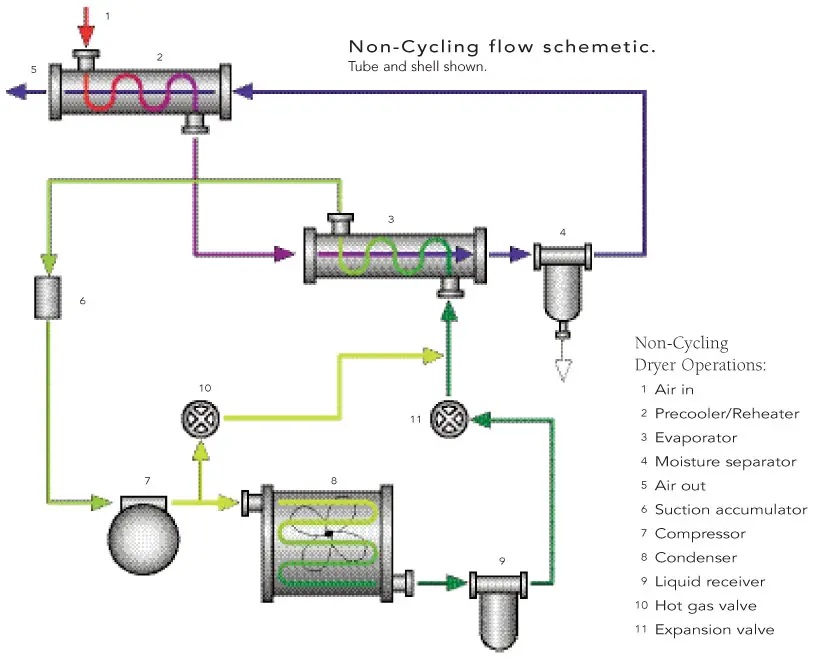
This guide provides a structured approach to troubleshooting and maintaining compressors, essential equipment in process industries. For applications that require vacuum generation, see our comprehensive guide on sizing steam jet ejectors and condensers. Compressors increase gas pressure by reducing volume, powering critical equipment. Compressor problems, such as reduced pressure, overheating, vibration, or surging, can lead to costly downtime. Understanding compressor operation, common problems, and troubleshooting is crucial for process engineers and maintenance personnel.
Compressor maintenance is a critical investment, ensuring reliability, efficiency, safety, and cost-effectiveness. Preventive maintenance ensures optimal performance and longevity, minimizing unexpected breakdowns. Regular maintenance reduces the risk of accidents, saves energy, prevents costly repairs, and promotes environmental responsibility. A well-maintained compressor contributes to consistent process performance, reduced energy consumption, and a safer working environment.
This guide covers compressor fundamentals, thermodynamics, performance parameters, common problems, data-driven troubleshooting, calculation methods, and troubleshooting examples. It aims to equip process engineers and maintenance personnel with the knowledge and tools for effective compressor maintenance, ensuring reliable and efficient operation.
2. Main Concepts
What are the key principles for compressor troubleshooting and maintenance?
This section introduces fundamental concepts for effective compressor troubleshooting and maintenance. A solid understanding of these concepts is crucial for accurate diagnosis and appropriate solutions.
2.1. Types of Compressors (Reciprocating, Rotary Screw, Centrifugal)
What are the differences between reciprocating, rotary screw, and centrifugal compressors?
Compressors are broadly categorized into positive displacement and dynamic types. This guide focuses on three common types: reciprocating, rotary screw, and centrifugal compressors.
- Reciprocating Compressors: These positive displacement compressors use a piston within a cylinder to compress gas. They are known for their ability to achieve high pressures and are commonly used in applications requiring intermittent operation. They are further categorized into single-acting and double-acting designs, as well as lubricated and oil-free models.
- Rotary Screw Compressors: These positive displacement compressors utilize two intermeshing screws to compress gas. They are favored for continuous operation and are commonly found in industrial settings. They are available in oil-flooded, water-flooded, and oil-free configurations.
- Centrifugal Compressors: These dynamic compressors use a rotating impeller to accelerate gas and convert kinetic energy into pressure. They are well-suited for high-flow applications and are commonly used in large industrial plants. They are known for their efficiency and reliability in continuous operation. Centrifugal compressors are less effective at very high pressure ratios compared to reciprocating compressors.
2.2. Key Compressor Components and Their Functions
What are the essential parts of a compressor and what do they do?
Understanding the function of each component is essential for effective troubleshooting. Key components include: inlet valve/suction valve, discharge valve, piston/rotor, cylinder, screws/rotors, impeller, stator, bearings, seals, lubrication system, cooling system, drive motor, control system, and unloader valve. Each component plays a vital role in the compression process.
2.3. Thermodynamics of Compression (Isothermal, Adiabatic, Polytropic)
How do isothermal, adiabatic, and polytropic processes affect compression?
The compression process is governed by thermodynamic principles. The three ideal thermodynamic processes are:
- Isothermal Compression: Compression at a constant temperature. This process requires continuous heat removal and is the most energy-efficient but difficult to achieve in practice. The ideal gas law is \(PV = \text{constant}\).
- Adiabatic Compression: Compression with no heat transfer to or from the gas. This process results in a temperature increase and is less efficient than isothermal compression. The relationship between pressure and volume is \(PV^{\gamma} = \text{constant}\), where \(\gamma\) is the isentropic exponent. The temperature change is calculated as: \[ T_2 = T_1 \left(\frac{P_2}{P_1}\right)^{\frac{\gamma-1}{\gamma}} \]
- Polytropic Compression: A more realistic model that accounts for some heat transfer during compression. The polytropic process lies between isothermal and adiabatic compression. The relationship between pressure and volume is \(PV^{n} = \text{constant}\), where \(n\) is the polytropic exponent. The temperature change is calculated as: \[ T_2 = T_1 \left(\frac{P_2}{P_1}\right)^{\frac{n-1}{n}} \]
2.4. Compressor Performance Parameters (Pressure Ratio, Flow Rate, Efficiency)
What metrics are used to evaluate compressor performance?
Key performance parameters evaluate compressor operation and potential problems:
- Pressure Ratio: The ratio of discharge pressure to suction pressure (\(R = P_d / P_s\)).
- Flow Rate: The volume of gas delivered per unit time, typically measured in actual cubic feet per minute (ACFM) or standard cubic feet per minute (SCFM). SCFM = \(\text{ACFM} \times (P_s / P_{\text{std}}) \times (T_{\text{std}} / T_s)\).
- Efficiency: Measures how effectively the compressor converts input power into compressed gas output. Metrics include volumetric efficiency (\(\eta_v = \text{ACFM} / \text{Displacement}\)), isentropic efficiency (\(\eta_s = \text{Isentropic Work} / \text{Actual Work}\)), and overall efficiency (\(\eta_o = \text{Isothermal Power} / \text{Actual Power Input}\)).
2.5. Common Compressor Problems and Symptoms
What are the typical issues that can occur with compressors and how can they be identified?
Recognizing common problems and their symptoms is crucial for efficient troubleshooting. Frequent issues include high discharge temperature, low discharge pressure, excessive vibration, high power consumption, seal leaks, surging, and unusual noise.
3. Data Tables
What reference data is useful for compressor maintenance and troubleshooting?
3.1. Typical Compressor Oil Specifications
What are the recommended oil types for different compressor types?
Warning : these are general considerations but the oil spec is specific to each machine
| Property | Reciprocating Compressor Oil (Petroleum-Based) | Rotary Screw Compressor Oil (Synthetic) | Centrifugal Compressor Oil (Synthetic) |
|---|---|---|---|
| ISO Viscosity Grade | 100 or 150 | 32, 46, or 68 | 32 or 46 |
| Viscosity Index | > 95 | > 120 | > 110 |
| Pour Point | < -15°C (5°F) | < -40°C (-40°F) | < -30°C (-22°F) |
| Flash Point | > 230°C (446°F) | > 240°C (464°F) | > 220°C (428°F) |
Note: Always consult the Original Equipment Manufacturer (OEM) manual and a lubrication specialist for the correct oil specification. Using the wrong oil can lead to catastrophic equipment failure.
3.2. Common Troubleshooting Scenarios
What are the potential causes of common compressor issues?
| Symptom | Possible Causes |
|---|---|
| High Discharge Temperature | 1. Insufficient cooling (dirty cooler, low coolant flow) 2. Low oil level or incorrect oil type 3. Worn bearings or seals 4. Internal recirculation or leakage 5. Thermostatic valve malfunction |
| Low Discharge Pressure | 1. Air intake filter clogged 2. Worn piston rings or valves (reciprocating) 3. Worn rotors (screw) 4. Leaks in the discharge piping 5. Unloader valve stuck open |
| Excessive Vibration | 1. Misalignment between motor and compressor 2. Unbalanced rotating components (impeller, rotors) 3. Worn bearings 4. Loose mounting bolts 5. Surging (centrifugal) |
| High Power Consumption | 1. High discharge pressure 2. Clogged inlet or discharge filters 3. Incorrect oil viscosity 4. Mechanical friction from worn parts 5. Operating off-design point |
| Surging (Centrifugal) | 1. Low inlet flow (process demand change) 2. Fouling on impeller or diffuser vanes 3. Malfunctioning anti-surge control system 4. Changes in gas composition or temperature |
4. Calculation Methods and Examples & Interactive Tool
What are some practical calculations used in compressor analysis?
Interactive Compressor Sizing & Performance Calculator
Evaluate discharge temperature, actual power required, and volumetric efficiency based on process conditions. Switch units seamlessly between SI Metric and US Customary.
🌿 Practical Plant Engineering Rules of Thumb & Safety Limits
- Discharge Temperature Limits: Never allow continuous discharge temperature to exceed 150°C (300°F) for synthetic oils and 135°C (275°F) for mineral oils to prevent lubricant coking, varnish formation, and auto-ignition.
- Pressure Ratio per Stage: Limit single-stage reciprocating pressure ratio to \(R \le 4.0\) (maximum 5.0 for low molecular weight gases) to keep discharge temperatures and valve wear within acceptable metallurgical limits.
- Design Margins: Size compressor motor drivers with a minimum 10% to 15% power safety margin over the maximum anticipated operating load and worst-case fouling.
- Surge Margin (Centrifugal): Maintain at least a 10% to 15% volumetric flow buffer between normal operating point and the calculated surge limit.
4.1. Discharge Temperature (Polytropic)
This calculation determines the theoretical discharge temperature for a polytropic compression process. Crucially, all thermodynamic calculations involving temperature ratios must use an absolute scale (Rankine for Imperial, Kelvin for SI).
- Formula: \[ T_2 = T_1 \cdot \left(\frac{P_2}{P_1}\right)^{\frac{n-1}{n}} \]
- Inputs:
- Inlet Temperature (\(T_1\)): 70°F
- Inlet Pressure (\(P_1\)): 14.7 psia
- Discharge Pressure (\(P_2\)): 120 psia
- Polytropic Exponent (\(n\)): 1.3
- Procedure:
- Convert inlet temperature to the absolute scale (Rankine):
\(T_1 \text{ (°R)} = T_1 \text{ (°F)} + 459.67\)
\(T_1 = 70 + 459.67 = \mathbf{529.67 \text{ °R}}\) - Calculate the pressure ratio (\(R\)):
\(R = P_2 / P_1 = 120 / 14.7 = 8.163\) - Calculate the exponent:
\((n-1)/n = (1.3 - 1) / 1.3 = 0.2308\) - Calculate the absolute discharge temperature (\(T_2\) in °R):
\(T_2 \text{ (°R)} = 529.67 \cdot (8.163)^{0.2308} = 529.67 \cdot 1.745 = \mathbf{924.3 \text{ °R}}\) - Convert the result back to Fahrenheit:
\(T_2 \text{ (°F)} = T_2 \text{ (°R)} - 459.67\)
\(T_2 = 924.3 - 459.67 = \mathbf{464.6 \text{ °F}}\)
- Convert inlet temperature to the absolute scale (Rankine):
- Result: The expected discharge temperature is 465°F.
4.2. Compressor Power (Isentropic)
This calculation determines the actual power required by a compressor, accounting for its isentropic efficiency. This example requires using absolute temperatures and standard physical constants.
- Formula: \[ W_{\text{actual}} = \frac{m \cdot C_p \cdot T_1 \cdot \left[\left(\frac{P_2}{P_1}\right)^{\frac{\gamma-1}{\gamma}} - 1\right]}{\eta_s} \]
- Inputs:
- Mass Flow Rate (\(m\)): 10 lb/s
- Inlet Temperature (\(T_1\)): 60°F
- Inlet Pressure (\(P_1\)): 20 psia
- Discharge Pressure (\(P_2\)): 200 psia
- Isentropic Exponent (\(\gamma\) for air): 1.4
- Isentropic Efficiency (\(\eta_s\)): 0.75
- Constants and Conversions:
- Specific Heat of Air (\(C_p\)): 0.24 BTU/lb·°R
- Horsepower Conversion: 1 HP \(\approx\) 0.7068 BTU/s
- Procedure:
- Convert inlet temperature to Rankine:
\(T_1 = 60\text{°F} + 459.67 = \mathbf{519.67 \text{ °R}}\) - Calculate the isentropic work in thermal units (BTU/s):
\(W_{\text{isen}} = 10 \text{ lb/s} \cdot 0.24 \text{ BTU/lb·°R} \cdot 519.67 \text{ °R} \cdot \left[\left(\frac{200}{20}\right)^{\frac{1.4-1}{1.4}} - 1\right]\)
\(W_{\text{isen}} = 1247.2 \cdot [10^{0.2857} - 1] = 1247.2 \cdot [1.9306 - 1] = 1160.6 \text{ BTU/s}\) - Convert isentropic work to horsepower (HP):
\(W_{\text{isen}} \text{ (HP)} = 1160.6 \text{ BTU/s} / 0.7068 \text{ BTU/s/HP} = \mathbf{1642 \text{ HP}}\) - Calculate the actual power using the efficiency:
\(W_{\text{actual}} = W_{\text{isen}} / \eta_s = 1642 \text{ HP} / 0.75 = \mathbf{2189.3 \text{ HP}}\)
- Convert inlet temperature to Rankine:
- Result: The actual power required is 2190 HP.
4.3. Volumetric Efficiency (Reciprocating)
This calculation estimates the efficiency of a reciprocating compressor in drawing gas into the cylinder, accounting for the clearance volume.
- Formula: \[ \eta_v = 1 - C \cdot \left[\left(\frac{P_d}{P_s}\right)^{\frac{1}{k}} - 1\right] \]
- Inputs:
- Clearance (\(C\)): 5% or 0.05
- Suction Pressure (\(P_s\)): 15 psia
- Discharge Pressure (\(P_d\)): 100 psia
- Specific Heat Ratio (\(k\)): 1.4
- Calculation:
\(\eta_v = 1 - 0.05 \cdot \left[\left(\frac{100}{15}\right)^{\frac{1}{1.4}} - 1\right]\)
\(\eta_v = 1 - 0.05 \cdot [6.67^{0.714} - 1]\)
\(\eta_v = 1 - 0.05 \cdot [3.896 - 1]\)
\(\eta_v = 1 - 0.05 \cdot 2.896 = 1 - 0.1448 = 0.8552\) - Result: The volumetric efficiency is 85.5%.
5. Troubleshooting Examples
Can you provide some real-world examples of compressor troubleshooting?
5.1. High Discharge Temperature in a Rotary Screw Compressor
What steps should be taken to troubleshoot high discharge temperature in a rotary screw compressor?
A rotary screw air compressor is tripping on high discharge temperature. The troubleshooting process should follow a logical sequence, starting with the simplest and most common causes. First, check external factors: verify the ambient temperature is not excessive and ensure the compressor's ventilation is not blocked. Next, inspect the cooling system. Check the oil cooler for dirt or debris blocking airflow and clean it if necessary. Verify the oil level is correct, as low oil can cause overheating. If these external checks do not resolve the issue, the problem may be internal. Investigate the thermostatic mixing valve to ensure it is functioning correctly and not bypassing the cooler. Finally, if the problem persists, consider a malfunctioning oil pump or internal wear causing excessive friction.
5.2. Frequent Surging in a Centrifugal Compressor
How do you diagnose and address frequent surging in a centrifugal compressor?
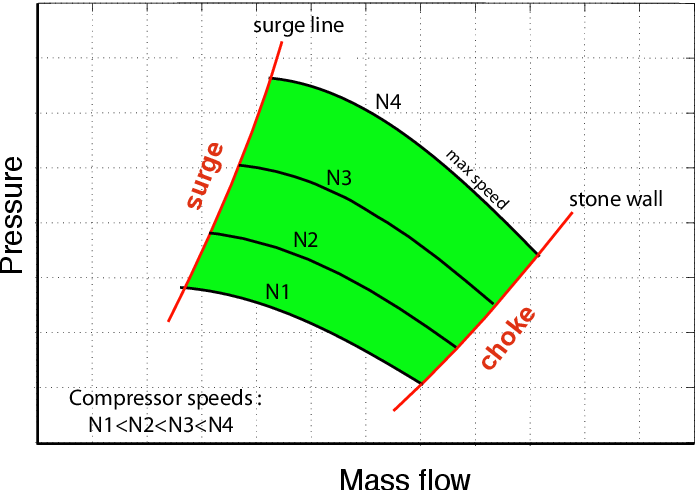
A centrifugal compressor in a chemical plant is experiencing frequent surging, causing process upsets. The first step is to verify the compressor's current operating point by comparing the measured inlet flow, pressure ratio, and speed to the manufacturer's performance map. If the operating point is near the surge line, the cause is likely a process condition such as a downstream demand drop. If the point should be stable, the next step is to investigate the anti‑surge control system; check that the anti‑surge valve is not stuck closed and confirm the controller, sensors, and transmitters are properly calibrated. For detailed guidance on designing and sizing anti‑surge loops, consult our anti‑surge loop sizing calculator. A slow or inaccurate control loop is a common cause of surging.
5.3. Excessive Vibration Troubleshooting
Excessive vibration in compressors is a critical reliability issue. Persistent vibration can lead to shaft misalignment, bearing damage, seal failures, and even structural fatigue of the skid or piping. A structured troubleshooting approach is essential:
- Mechanical Imbalance: Check for rotor imbalance, worn bearings, or coupling misalignment. Verify that the compressor foundation and hold-down bolts are secure.
- Piping Resonance: Inspect suction and discharge piping supports for looseness or resonance effects. In some cases, acoustic pulsation dampers may be needed.
- Operating Conditions: Review whether the compressor is running far off its design point (e.g., very low flow). Off-design operation can induce surge-related oscillations and mechanical stresses.
- Corrective Actions: Balance the rotor, realign couplings, reinforce supports, and adjust operating conditions to the manufacturer’s recommended range. In persistent cases, consult a vibration specialist to perform an FFT (Fast Fourier Transform) analysis.
5.4. High Power Consumption Troubleshooting
Excessive power draw leads to higher operating costs and may indicate mechanical or process inefficiencies. Typical root causes include:
- Dirty or Fouled Heat Exchangers: If intercoolers or aftercoolers are scaled, the compressor must work harder due to elevated discharge temperatures.
- Incorrect Valve Operation: Leaking suction or discharge valves (in reciprocating compressors) cause internal recirculation and inefficiency.
- Operating Away from Design Point: Running at higher pressures or flows than specified dramatically increases power requirements.
- Mechanical Issues: Excessive bearing friction, poor lubrication, or rubbing parts increase shaft horsepower demand.
- Corrective Actions: Clean or replace fouled exchangers, inspect valves, confirm operating pressures, and ensure lubrication is correct. Trending kW draw versus flow is a best practice to detect early deviations.
5.5. Seal Leaks Troubleshooting
Seal integrity is critical, particularly in oil-free or hazardous gas service. Even minor leaks can compromise process safety or air purity. Troubleshooting involves:
- Mechanical Seal Wear: Over time, faces degrade, leading to leaks.
- Improper Seal Gas Pressure (Dry Gas Seals): If buffer or barrier gas pressures are not maintained, inward or outward leakage can occur.
- O-ring or Gasket Deterioration: Elastomers may be chemically attacked or thermally degraded.
- Installation and Alignment Issues: Poor seal installation or shaft misalignment accelerates wear.
- Corrective Actions: Replace worn seals, verify seal gas supply systems, use compatible elastomers, and ensure proper alignment. For instrument air compressors, oil carry-over through seals may necessitate switching to dry, oil-free configurations.
5.6. Frequent Surging Troubleshooting
Surging is a dynamic instability where flow reverses periodically, leading to damaging pressure oscillations. It is especially relevant in centrifugal compressors. Key diagnostic points include:
- Operating Below Minimum Stable Flow: Ensure a proper anti-surge control system is in place with reliable recycle valves.
- Inadequate Instrumentation: Poorly tuned surge detection or slow recycle valves allow instability to develop.
- System Design Issues: Long discharge piping or improper volume bottles can worsen surge susceptibility.
- Sudden Demand Fluctuations: Rapid downstream valve closures can push the compressor into surge.
- Corrective Actions: Review and re-tune the anti-surge control logic, verify recycle valve speed and capacity, and consider adding surge suppression devices if system design is inherently prone. Operators should avoid throttling downstream too abruptly.
FAQ: Compressor Troubleshooting and Maintenance
1. Why is compressor maintenance important?
Compressor maintenance ensures reliability, efficiency, safety, and cost-effectiveness. It prevents unexpected breakdowns, reduces energy consumption, minimizes repair costs, and promotes environmental responsibility.
2. What are the main types of compressors and their differences?
Main types include: - Reciprocating Compressors: High-pressure, intermittent operation, single/double-acting. - Rotary Screw Compressors: Continuous operation, oil-flooded/water-flooded/oil-free. - Centrifugal Compressors: High-flow, continuous operation, less effective at very high pressure ratios.
3. What are the key components of a compressor?
Key components include: inlet/suction valve, discharge valve, piston/rotor, cylinder, impeller, bearings, seals, lubrication system, cooling system, drive motor, and control system.
4. What are the thermodynamic processes in compression?
- Isothermal: Constant temperature, most efficient but impractical. - Adiabatic: No heat transfer, temperature increases. - Polytropic: Intermediate between isothermal and adiabatic, accounts for some heat transfer.
5. What are the key performance parameters for compressors?
Key parameters include: - Pressure Ratio: Discharge pressure / suction pressure. - Flow Rate: Volume of gas delivered (ACFM/SCFM). - Efficiency: Volumetric, isentropic, and overall efficiency.
6. What are common compressor problems and their symptoms?
Common issues include high discharge temperature, low discharge pressure, excessive vibration, high power consumption, seal leaks, surging, and unusual noise.
7. How do you calculate discharge temperature in a polytropic process?
Use the formula: \[ T_2 = T_1 \cdot \left(\frac{P_2}{P_1}\right)^{\frac{n-1}{n}} \] Where \( T_1 \) and \( T_2 \) are absolute temperatures, \( P_1 \) and \( P_2 \) are pressures, and \( n \) is the polytropic exponent.
8. How is compressor power calculated?
Actual power is calculated as: \[ W_{\text{actual}} = \frac{m \cdot C_p \cdot T_1 \cdot \left[\left(\frac{P_2}{P_1}\right)^{\frac{\gamma-1}{\gamma}} - 1\right]}{\eta_s} \] Where \( m \) is mass flow rate, \( C_p \) is specific heat, \( \gamma \) is the isentropic exponent, and \( \eta_s \) is isentropic efficiency.
9. How is volumetric efficiency calculated for reciprocating compressors?
Volumetric efficiency (\( \eta_v \)) is calculated as: \[ \eta_v = 1 - C \cdot \left[\left(\frac{P_d}{P_s}\right)^{\frac{1}{k}} - 1\right] \] Where \( C \) is clearance, \( P_d \) is discharge pressure, \( P_s \) is suction pressure, and \( k \) is the specific heat ratio.
10. How do you troubleshoot high discharge temperature in a rotary screw compressor?
Check ambient temperature, ventilation, cooling system (oil cooler, oil level), thermostatic valve, and internal components like the oil pump for malfunctions.
- https://www.psgdover.com/docs/default-source/blackmer-docs/training-materials/cb207.pdf?sfvrsn=b86a1445_5
- https://www.torr-engenharia.com.br/wp-content/uploads/2011/05/VacuumPumpsCommonProblemsandTroubleshooting.pdf
- https://www.achrnews.com/articles/152881-what-causes-high-compressor-discharge-temperatures