
Tank agitator pumping numbers
Pumping numbers of common agitators
Question or remark ? Please contact us at contact@myengineeringtools.com
2. Types of agitators
3. Pumping number of common agitators
4. Agitator pumping capacity free calculator
This page is giving some references of pumping numbers for common agitators.
1. Introduction
It is very important when designing an agitated tank to calculate the power that will be required to agitate efficiently the tank. It can be done by knowing the Power Number of a specific agitator. However it is also required to make sure that the overall circulation of fluid in the tank is enough, which can be done by calculating the amount of fluid that an agitator can pump. The pumping flow will be the volume of liquid that is passing through the agitator over one second.
To calculate the pumping flow, it is required to know the Pumping Number of an agitator.
In SI units, the pumping number is defined as:
\(N_q = Q / (N \cdot D^3)\)
With:
\(Q\) = pumping capacity (or pumping flow) (\(m^3/s\))
\(N_q\) = pumping number (-)
\(D\) = impeller diameter (\(m\))
\(N\) = agitator speed (\(r/s\) or \(s^{-1}\))
If the pumping number of an agitator is known, it is then possible to calculate the pumping capacity as:
\(Q = N_q \cdot N \cdot D^3\)
Now the question is to find out what is the pumping number for a particular agitator. The best is still to carry out pilot plant trials to define it, or ask specifically to a manufacturer, however it is not always possible and sometimes in pre-project or during troubleshooting we need to be able to make some rough calculations. In such cases, it is possible to use pumping numbers tabulated for common agitators geometry.
When the Reynolds number is higher than 10000, those pumping numbers are constant which makes such references particularly useful when the flow in the tank is turbulent.
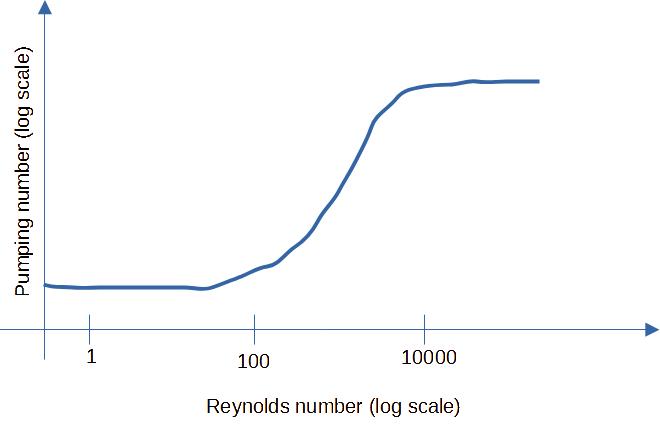
Figure 1: Pumping number as a function of Reynolds number,
notice as the Pumping number tends to stay constant at Re >
10000
💡 PLANT ENGINEERING RULES OF THUMB
- Tip Speed Limits: Standard impeller tip speed (\( v_{tip} = \pi \cdot D \cdot N \)) should typically stay between \( 1.5 - 3.0 \text{ m/s} \) for simple solid suspension, \( 3.0 - 4.5 \text{ m/s} \) for intense liquid blending, and limit to \( < 6.0 \text{ m/s} \) to avoid excessive shear or structural vibration.
- Viscous Sizing Penalties: Standard pumping numbers assume fully turbulent flow (\( Re > 10,000 \)). If operating in transitional flow (\( 10 < Re < 10,000 \)), pumping performance drops off significantly.
- Agitator Diameter Ratio: Typically, the ratio of impeller diameter (\(D\)) to tank diameter (\(T\)) should be \( D/T \approx 0.3 \text{ to } 0.4 \) for axial flow impellers.
2. Types of agitators
The following agitators are considered in this page :
-
"Marine" propeller
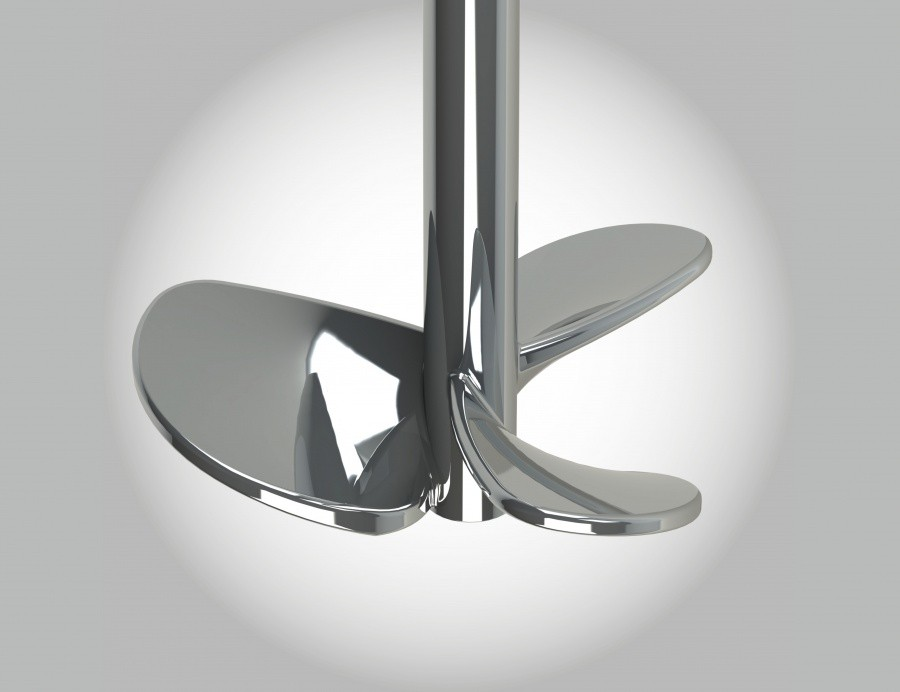
- Curved blade turbine (retreat curve impeller)
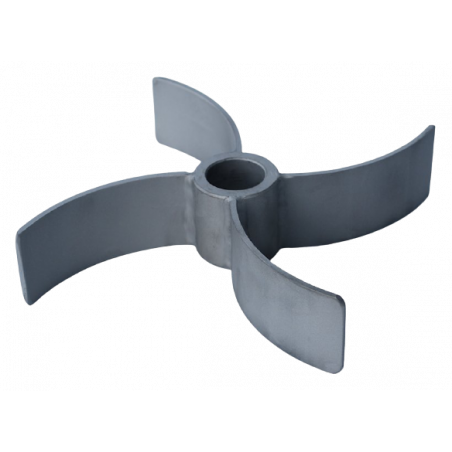
- Pitched blade turbine
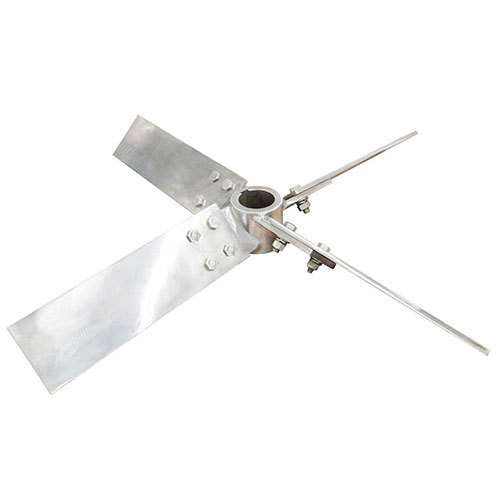
- Flat blade turbine
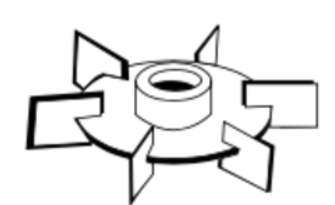
- Hollow blade turbine (Smith)

- Hydrofoil
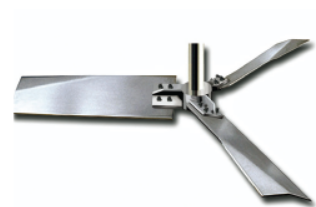
3. Pumping number of common agitators
For Reynolds numbers > 10000, the following pumping numbers are estimated for each of the agitators' geometry.
| Agitator type | Pumping number Nq |
| Propeller | 0.4-0.6 [Hall] 0.5-0.7 [Dynamix] 0.5 [Michigan] |
| Pitched blade turbine | 0.79 [Hall] 0.87 [Michigan] 0.7-0.9 [Dynamix] |
| Hydrofoil impeller | 0.55-0.73 [Hall] 0.6-0.7 [Dynamix] |
| Flat blade turbine | 0.7 [Hall] 1-1.2 [Dynamix] |
| Disk flat blade turbine (Rushton) | 0.72 [Hall] 1.3 [Michigan] |
| Hollow blade turbine (Smith) | 0.76 [Hall] |
| Retreat curve impeller | 0.3 [Hall] |
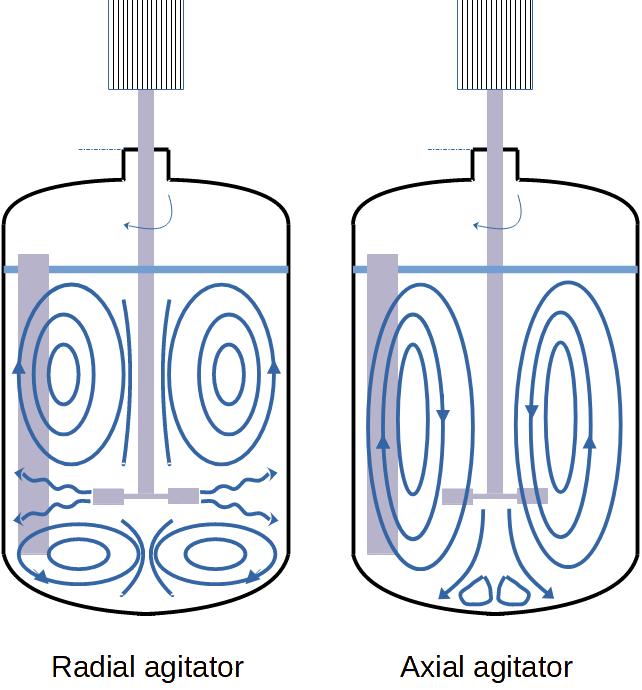
In terms of patterns of agitation in the tanks, this will depend on whether the agitator is "radial" or "axial". Typical agitation patterns for each type is given on the graph below:
4. Agitator pumping capacity free calculator
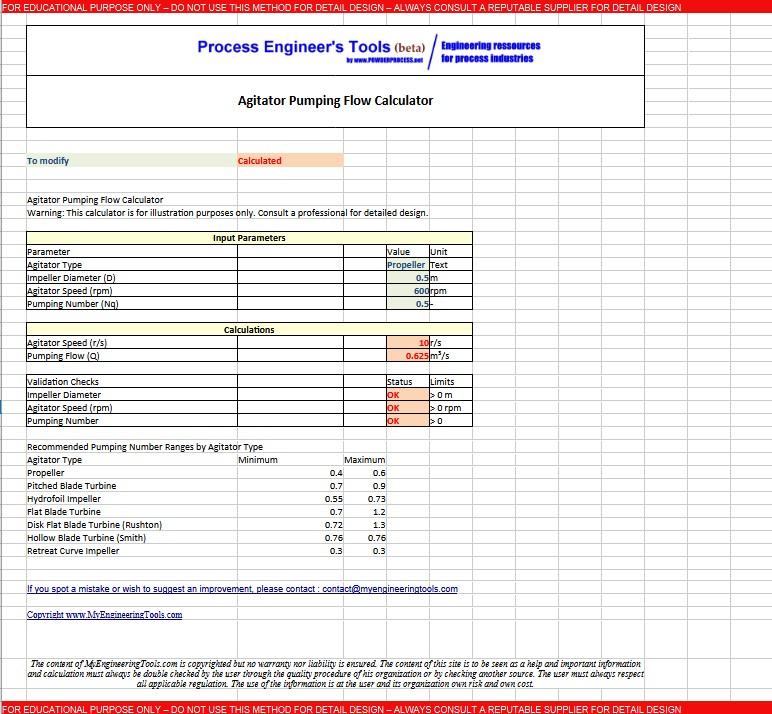
4.1 Excel Calculator
Warning: this calculator is provided to illustrate the concepts mentioned in this webpage, it is not intended for detail design. It is not a commercial product, no guarantee is given on the results. Please consult a reputable designer for all detail design you may need.
4.2 Online Calculator
Results
FAQ: Tank Agitator Pumping Numbers
1. What is the pumping number of an agitator?
The pumping number (\( N_q \)) is a dimensionless number that relates the pumping capacity (\( Q \)) of an agitator to its speed (\( N \)) and impeller diameter (\( D \)). It is defined as: \[ N_q = \frac{Q}{N \cdot D^3} \] Where \( Q \) is in m³/s, \( N \) is in r/s, and \( D \) is in meters.
2. How is the pumping capacity of an agitator calculated?
If the pumping number (\( N_q \)) is known, the pumping capacity (\( Q \)) can be calculated as: \[ Q = N_q \cdot N \cdot D^3 \]
3. What are typical pumping numbers for common agitators?
For Reynolds numbers > 10,000 (turbulent flow), typical pumping numbers are:
- Propeller: 0.4–0.7
- Pitched blade turbine: 0.7–0.9
- Hydrofoil impeller: 0.55–0.73
- Flat blade turbine: 0.7–1.2
- Hollow blade turbine (Smith): 0.76
- Retreat curve impeller: 0.3
4. Why are pumping numbers constant at high Reynolds numbers?
At Reynolds numbers > 10,000, pumping numbers become constant because the flow is turbulent, and the agitator's geometry dominates the pumping behavior.
5. How do agitator types affect pumping patterns?
Radial agitators (e.g., flat blade turbines) create radial flow patterns, while axial agitators (e.g., propellers) create axial flow patterns, influencing fluid circulation in the tank.
6. Are there tools available to calculate pumping flow?
Yes, our website offers a free Excel calculator and an Online tool to estimate pumping flow based on agitator type, pumping number, impeller diameter, and speed.
7. What precautions should be taken when using the calculator?
The calculator provides approximations for quick estimations. For detailed design, consult a reputable engineer or designer.
8. How can pumping numbers be verified?
Pumping numbers can be verified through pilot plant trials or by consulting manufacturer specifications for specific agitator models.
9. What is the difference between pumping number and power number?
The pumping number (\( N_q \)) relates to the agitator's pumping capacity, while the power number (\( N_p \)) relates to the power required for agitation. Both are dimensionless and used in agitator design.
10. How does agitator speed affect pumping capacity?
Pumping capacity (\( Q \)) is directly proportional to agitator speed (\( N \)). Increasing speed increases the flow rate, assuming other parameters remain constant.
Sources
[Hall] Rules of thumb for Chemical Engineers, Hall, Elsevier, 2018,
pages 104-105
[Dynamix] Mixing 101: Flow Patterns & Impellers, dynamixinc.com,
https://dynamixinc.com/mixing-101-the-basic-principles-of-mixing-and-impellers/
[Michigan] Chapter 9 Agitation and mixing, University Michigan,
https://pages.mtu.edu/~fmorriso/cm310/fluids_lecture_15
Agitator Performance
For complete vessel calculations, optimize both pumping number & power number to guarantee correct gas retention or solid suspension limits.
Go to Power Numbers Agitator →