
Pump NPSH Calculator & Technical Guide
Net positive suction head (NPSHa vs NPSHr)
Follow us on Twitter 
Question, remark ? Contact us at contact@myengineeringtools.com
| Section summary |
|---|
| 1. Definition of
NPSH |
| 2. Interactive NPSH Calculator |
| 3. NPSH Calculation Formula |
| 4. Effect & Cavitation |
1. Definition : What is pump NPSH
Meaning of NPSH : the term pump NPSH stands for Net Positive Suction Head.
It represents the pressure drop in between the suction point of the pump and the minimum pressure that is reached at the pump inlet.
If the pump NPSH available ($NPSH_a$) is less than the NPSH required ($NPSH_r$), the pump will not work properly. Either the liquid will not be pumped (not possible to prime the pump) or the operation will generate cavitation.
⚡ Interactive Pump NPSH Calculator
2. NPSH Calculation : How to calculate the pump NPSH
NPSH required - NPSHr
The NPSH required for a given pump is given by the pump manufacturer. It can be read on the pump characteristic curve.
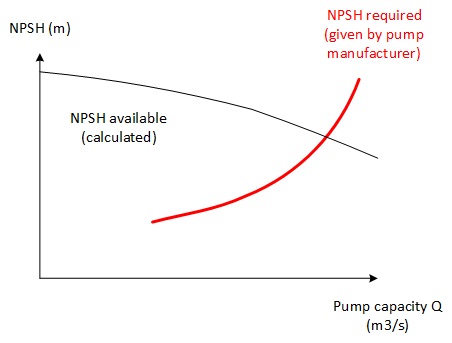
Figure 1 : Pump NPSH, required and available
NPSH available - NPSHa
The NPSH available needs to be calculated from the actual suction pipe layout of the pump. The following case is considered below :

Figure 2 : Pump circuit
The NPSH formula is given below :

Equation 1 : NPSH calculation [Midoux]
Note : in many cases the velocity head \(u_1^2/2g\) is negligible which simplifies the relation [Sihi]
With :
- \(h_1\) = height from the level of liquid to centrifugal
pump axis (m)
- \(p_1\) = pressure of the tank from which liquid is pumped
(Pa)
- \(p_v\) = vapor pressure of liquid pumped (Pa)
- \(u_1\) = velocity of liquid in the suction pipe (m/s)
- \(\Delta H_f\) = pressure drop by friction in the suction pipe (m)
- \(\rho\) = specific gravity/density of liquid pumped (kg/m³)
- \(g\) = gravitational acceleration (\(9.81\text{ m/s}^2\))
If the NPSH available is very low, it is important to select a low NPSH pump so that it can still suck the liquid without cavitation.
💡 Plant Engineering Best Practices & NPSH Rules of Thumb
- Suction Line Velocity: Sizing suction lines for liquid velocities between 0.6 and 1.2 m/s (2 to 4 ft/s) prevents cavitation, minimizes dynamic turbulence, and restricts friction pressure drops. Avoid velocities above 1.5 m/s (5 ft/s).
- NPSH Safety Margin: Always maintain a absolute safety margin: \(NPSH_a \ge NPSH_r + 0.6\text{ m}\) (2 ft) or a ratio of \(NPSH_a / NPSH_r \ge 1.15\) to \(1.30\) (per Hydraulic Institute standards).
- Suction Piping Geometry: Install eccentric reducers with the flat side on top to eliminate high-point air pockets. Provide a minimum straight pipe length of 5 to 10 pipe diameters directly before the pump inlet flange.
- Hot/Volatile Liquids: For fluids near their boiling point (e.g. boiler feedwater, hot condensates, hydrocarbons), increase static suction head \(h_1\) by elevating tanks or sub-cooling the feed liquid.
NPSH calculation example
Refering to figure 2, a pump is installed at the outlet of a tank, to transfer water to another tank. It pumps 10 m3/h.
The tank is at atmospheric pressure, the pipe internal diameter is 60 mm, the height difference in between the level of liquid in tank 1 and the pump is 2 m. Water is at 20°C.
STEP 1 : calculate the liquid vapor pressure
The vapor pressure can be either read from tables or calculated thanks to an Antoine law. For water at 20°C : 2339 Pa.
STEP 2 : calculate the velocity in pipe
The velocity is 10/(π*0.062/4)= 3536 m/h = 0.98 m/s.
Note : in this example, the pipe is short and the velocity low, friction losses are neglected, if it is not the case and you wish to calculate the pressure loss, please refer here.
STEP 3 : calculate the NPSH
NPSH = 2+(101325-2339)/(9.81*998)+0.982/(2*9.81)+0=2+10.11+0.05=12.16 m
3. Effect
An NPSH available too low will lead to operation issues for the pump, especially a decrease in flowrate and the risk of cavitation.
Source
[Sihi] Basic Principles for the Design of Centrifugal Pump Installations, 2003