
System Parameters
Results
Psuction = P1 + (h1 × spgr / 10.2) - ΔPf
NPSHa = (Psuction - Psat) × 10.2 / spgr
Cavitation Assessment:
• Safe: NPSHa > NPSHr + margin
• Warning: NPSHr < NPSHa ≤ NPSHr + margin
• Danger: NPSHa ≤ NPSHr
Follow us on Twitter ![]()
Question, remark ? Contact us at contact@myengineeringtools.com
| Section summary |
|---|
| 1. Definition : what is pump cavitation ? |
| 2. How to fix pump cavitation : calculation |
| 3. Consequences : what are the
effects of pump cavitation |
| 4. Calculator : pump at risk of cavitation ? |
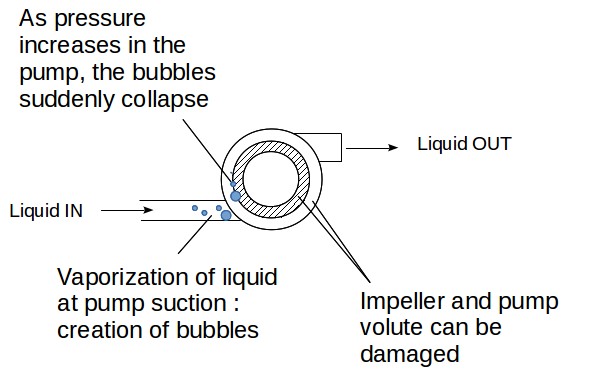
The phenomena of pump cavitation is due to the vaporisation of the liquid pumped at the entrance of the pump impeller. Bubbles formed then collapse within the impeller when the pressure goes up again. The quick collapse of the bubbles translates in high forces that can damage the pump impeller.

Cavitation is very harmful for pumps.
Cavitation will happen if the pressure at impeller entry is below the saturation pressure of the liquid sucked. Static pressure decreases within the pump suction due to the acceleration of the fluid at the suction and pressure can go below the saturation pressure of the liquid.

Figure 1 : Pump cavitation - decrease of pressure at pump suction
Cavitation condition : Psuction - NPSH < Psat
Non Cavitation condition : Psuction - NPSH > Psat + margin
The NPSH
is given by the pump manufacturer.
In practice, a margin must be included in the design to
account for process variations (temperature...), it is to be
determined by the engineer according to what is acceptable for the
case studied (consider different liquid pressure, for example,
which can have as effect to change the vapor pressure of the liquid and
thus the pressure at which cavitation can appear), according to
the calculation codes applicable, or experience - some supplier,
if no other value is specified, will consider 0.5 m of margin.
The suction pressure is calculated by summing the pressure in
the vessel in which the liquid is pumped with the static
pressure of the liquid in the vessel minus the pressure drop due
to the suction line. It is therefore necessary to ensure that
there is sufficient pressure at the pump suction in order to
avoid cavitation.
Psuction = P1 + h1*spgr/10.2 - ΔPf
Note : conversion from bar to m of liquid : ΔP = H*spgr/10.2
- ΔP in bar
- H in m
- spgr in kg/m3

Figure 2 : Pump circuit
Cavitation in pumps has the following effects
Warning : this calculator is provided to illustrate the concepts mentioned in this webpage, it is not intended for detail design. It is not a commercial product, no guarantee is given on the results. Please consult a reputable designer for all detail design you may need.
Check if your pump is at risk of cavitation
Pump cavitation occurs when the liquid at the pump impeller entrance vaporizes due to low pressure, forming bubbles. These bubbles collapse within the impeller, causing high-pressure shocks that can damage the pump.
Cavitation is caused when the suction pressure (\( P_{\text{suction}} \)) minus the NPSH (Net Positive Suction Head) drops below the liquid's saturation pressure (\( P_{\text{sat}} \)).
Ensure \( P_{\text{suction}} - \text{NPSH} > P_{\text{sat}} + \text{margin} \). Increase suction pressure, reduce suction line losses, or use a pump with lower NPSH requirements.
NPSH (Net Positive Suction Head) is the minimum pressure required at the pump inlet to prevent cavitation. It is provided by the pump manufacturer and is critical for design.
Suction pressure (\( P_{\text{suction}} \)) is calculated as: \[ P_{\text{suction}} = P_1 + \frac{h_1 \times \text{spgr}}{10.2} - \Delta P_f \] Where: - \( P_1 \) = Vessel pressure (bar) - \( h_1 \) = Static head (m) - \( \text{spgr} \) = Specific gravity - \( \Delta P_f \) = Suction line pressure drop (bar).
Cavitation causes reduced pump capacity, noise, vibrations, and wear on the impeller and housing, leading to decreased performance and potential mechanical failure.
NPSH Available (\( \text{NPSHa} \)) is calculated as: \[ \text{NPSHa} = \left(P_{\text{suction}} - P_{\text{sat}}\right) \times \frac{10.2}{\text{spgr}} \]
A safe NPSH margin is when \( \text{NPSHa} > \text{NPSHr} + \text{margin} \). A common margin is 0.5 meters, but it varies based on application and codes.
Yes, our website offers a free online calculator to determine if your pump is at risk of cavitation based on system parameters.
The calculator is for illustrative purposes only. For detailed design, consult a reputable engineer or designer.