
Oxygen saturation concentration of water calculation step by step
How much oxygen can be dissolved in water at equilibrium ?
Follow us on Twitter 
Question, remark ? Contact us at contact@myengineeringtools.com
1. STEP 1 : Gather data
2. STEP 2 : Calculate the partial pressure of oxygen
3. STEP 3 : Calculate the mole fraction of oxygen in water
5. STEP 5 : Calculate the saturation concentration of oxygen in water in mg / l
Calculating the amount of oxygen dissolved in water can be useful in many Engineering disciplines but it is especially the case in Environmental Engineering. This page is presenting a step by step method to calculate the saturation concentration of oxygen in water. The calculations are focusing on equilibrium of water with air but a similar method could be used with another gas mixture containing oxygen, or even to calculate the saturation concentration in water of another component of the gas.
1. STEP 1 : Gather data
In order to calculate the saturation concentration of oxygen in water, the Engineer must know the following data :
\(P_g\) = ratio of partial pressure of oxygen to total pressure or mole fraction in gas (\(\text{mol O}_2 / \text{mol gas}\))
\(P_T\) = total gas pressure (\(\text{atm}\))
\(T\) = temperature of the water (\(^\circ\text{C}\))
\(H\) = Henry's law constant for oxygen at the temperature of interest (\(\text{atm}\))
2. STEP 2 : Calculate the partial pressure of oxygen
The partial pressure ratio of oxygen in the gas phase is expressed as:
\[ P_g = \frac{P_{\text{O}_2}}{P_T} \]Air is composed of approximately 20.95% oxygen, which means that the partial pressure ratio of oxygen in ambient air is about 0.2095 (\(P_{\text{gas}} = 0.21\text{ atm}\) at 1 atm total pressure).
3. STEP 3 : Calculate the mole fraction of oxygen in water
The calculation of the mole fraction of oxygen per mole of water is done using Henry's law, which links the mole fraction of a component in the liquid phase to its equilibrium partial pressure in the gas phase:
\[ x_g = \frac{P_T}{H} \cdot P_g = \frac{P_{\text{gas}}}{H} \]With :
\(x_g\) = molar fraction of oxygen in the water (\(\text{mol O}_2 / \text{mol water}\))
\(P_T\) = total pressure of the gas (\(\text{atm}\))
\(H\) = Henry's constant (\(\text{atm}\))
\(P_g\) = partial pressure fraction of oxygen in the gas phase (\(-\))
4. STEP 4 : Calculate the concentration of oxygen per liter of water
The next step is to calculate the concentration of oxygen in moles per liter of water. By definition, the molar fraction of oxygen in water is:
\[ x_g = \frac{n_g}{n_g + n_w} \]With :
\(x_g\) = molar fraction of oxygen in the water (\(\text{mol O}_2 / \text{mol water}\))
\(n_g\) = number of moles of oxygen in one liter of water (\(\text{mol}\))
\(n_w\) = number of moles of water in one liter of water (\(\text{mol}\))
To simplify the calculations, it is assumed that \(n_w \gg n_g\), which means that:
\[ x_g \approx \frac{n_g}{n_w} \implies n_g = x_g \cdot n_w \]5. STEP 5 : Calculate the saturation concentration of oxygen in water in mg / l
Now that the molar concentration per liter of water is known, it can be converted to mass concentration by multiplying by the molecular weight of \(\text{O}_2\):
\[ C_g = n_g \cdot M_g \cdot 1000 \]With :
\(C_g\) = mass concentration of oxygen in water (\(\text{mg/l}\) or \(\text{ppm}\))
\(n_g\) = number of moles of oxygen in one liter of water (\(\text{mol/l}\))
\(M_g\) = molecular weight of oxygen (\(\text{g/mol}\))
⚡ Interactive Gas Saturation Concentration Calculator
Calculation Results:
| Partial Pressure Ratio (\(P_g = P_{\text{gas}} / P_T\)): | 0.210 (-) |
| Mole Fraction in Water (\(x_g\)): | 4.88E-06 mol gas / mol water |
| Moles Dissolved per Liter (\(n_g\)): | 2.71E-04 mol gas / L water |
| Saturation Concentration (\(C_g\)): | 8.682 mg/l (ppm) |
Top 5 Most Popular
1. Compressor Power Calculation
2. Pump Power Calculation
3. Pipe Pressure Drop Calculation
4. Fluid Velocity in pipes
5. Churchill Correlation (friction factor)
6. Step by Step example : calculation of oxygen saturation concentration in water
An Engineer would like to calculate the amount of oxygen that should be dissolved in a pond at equilibrium (he can then compare to the actual amount measured by analysis to diagnose possible water quality issues)
Step 1 : collect the data
\(P_T\) = total gas pressure (\(\text{atm}\)) = 1 atm
\(T\) = temperature of the water (\(^\circ\text{C}\)) = 20 \(^\circ\text{C}\)
Henry's law constant for oxygen at the temperature of interest =
41100 atm for oxygen in water
Step 2 : Calculate the partial pressure of oxygen
\(P_g = \frac{P_{\text{O}_2}}{P_T} = 0.2095\)
Step 3 : Calculate the mole fraction of oxygen in water
\(x_g = \frac{P_T}{H} \cdot P_g = \frac{1\text{ atm}}{41100\text{ atm}} \times 0.2095 = 5.097 \times 10^{-6}\text{ mol gas / mol water}\)
Step 4 : Calculate the concentration of oxygen per liter of water
\(n_w = \frac{1000}{18} = 55.56\text{ mol of water / l of water}\)
\(n_g = x_g \cdot n_w = 5.097 \times 10^{-6} \times 55.56 = 2.83 \times 10^{-4}\text{ mol gas / liter of water}\)
Step 5 : Calculate the saturation concentration of oxygen in water in mg / l
\(C_g = 2.83 \times 10^{-4} \times 32 \times 1000 = 9.06\text{ mg/l}\)
The saturation concentration of oxygen in water at 20\(^\circ\text{C}\) (with \(H = 41100\text{ atm}\)) is 9.06 mg/l.
💡 Practical Engineering Rules of Thumb & Safety Limits
- Temperature Dependency: Dissolved oxygen (DO) solubility in water decreases sharply as temperature rises. Fresh water at 0°C holds up to ~14.6 mg/L DO, whereas at 30°C it drops to ~7.5 mg/L.
- Salinity & TDS Correction: Dissolved salts reduce gas solubility ("salting-out" effect). Seawater (35 ppt salinity) holds roughly 20% less dissolved oxygen than fresh water at identical temperatures and pressures.
- Elevation & Barometric Effect: Atmospheric pressure drops by ~12% per 1,000 meters altitude gain. Reduced barometric pressure proportionally lowers gas partial pressure ($P_{\text{gas}}$) and maximum saturation concentration.
- Biological Wastewater & Aeration Design: Aerobic treatment basins (e.g., activated sludge) maintain target DO levels around 1.5–2.5 mg/L. Aeration blower systems are typically sized with a 20–30% capacity margin over peak oxygen uptake rates (OUR).
7. Gas saturation concentration in water calculator Excel
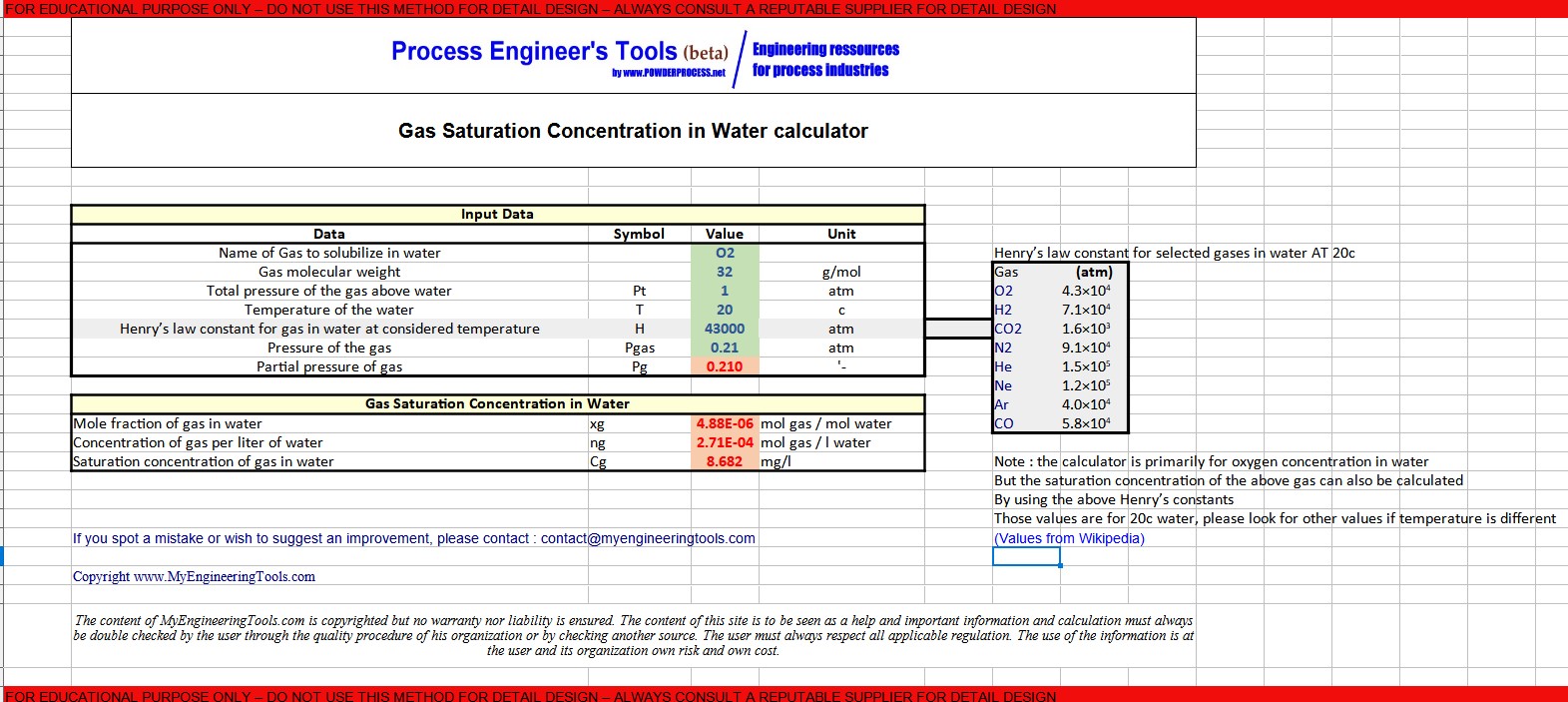
MyEngineeringTools.com has developed a free Excel calculator that allows you to calculate the gas saturation concentration in water : Gas saturation concentration in Water calculator Excel
Warning : this calculator is provided to illustrate the concepts mentioned in this webpage, it is not intended for detail design. It is not a commercial product, no guarantee is given on the results. Please consult a reputable designer for all detail design you may need.
Sources
[Chopey] Handbook of Chemical Engineering calculations, Chopey et al, McGraw Hill, 2004