Volume of a spherical tank : step by step calculation guide and calculator
How to calculate the volume of a spherical tank
What is the volume of a sphere ?
Follow us on Twitter 
Question, remark ? Contact us at contact@myengineeringtools.com
1. Spherical tank
4. STEP 3 : Calculate the volume of the spherical cap at height h
5. STEP 4 : Sphere volume calculation (full)
6. STEP 5 : Calculate the filled volume of the spherical tank at height h
7. Interactive Spherical Tank Volume Calculator
8. Spherical tank volume calculator Excel
1. Spherical tank
Spherical tanks are used in process industries for large storages of liquified gases such as ammonia, LPG, butadiene, propylene. Spherical vessels are particularly interesting for high pressure storage as the spherical shape is more advantgeous than cyclindrical ones to resist pressure (since pressure is evenly distributed) while it also reduces the surface of the tank relative to the volume compared to other tank designs.

Although spherical vessels must be properly insulated, the reduction of the surface is key to limit heat transfer to the stored liquid.
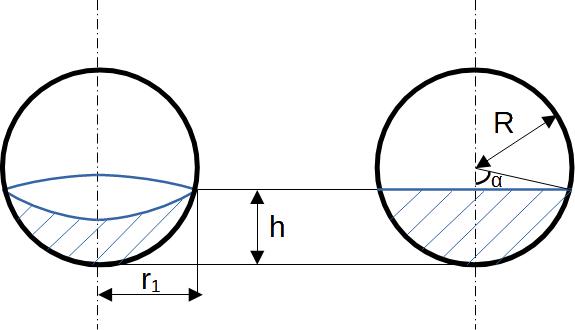
With :
\(R\) = tank radius (m)
\(h\) = actual height of liquid in the tank (m)
\(r_1\) = radius at the surface of the liquid level in the tank (m)
\(\alpha\) = angle from center of sphere to liquid level
This page is explaining how to calculate the volume in the tank as a function of the level of liquid h. To calculate the partial volume in the tank it is necessary to know the geometrical characteristics of the sphere (its diameter or radius) as well as the height of liquid from the bottom of the tank.
Top 5 Most
Popular
1. Compressor
Power Calculation
2. Pump Power Calculation
3. Pipe Pressure
Drop Calculation
4. Fluid Velocity in pipes
5. Churchill Correlation
(friction factor)
2. STEP 1 : Calculate the angle α
The angle \(\alpha\) can be calculated thanks to the following formula :
\[\cos(\alpha) = 1 - \frac{h}{R}\]
cos α = (1-h/R)
3. STEP 2 : Calculate the radius r1
The radius \(r_1\) which is radius of the pool of liquid can be calculated thanks to the following formula :
\[r_1 = (R - h) \tan(\alpha) = \sqrt{2Rh - h^2}\]
r1 = (R-h) tan α
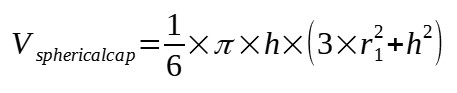
4. STEP 3 : Calculate the volume of the spherical cap at height h
The volume of the spherical cap can be calculated with the following formula :
\[V_{\text{spherical cap}} = \frac{1}{6} \pi h \left(3 r_1^2 + h^2\right)\]
5. STEP 4 : Sphere volume calculation (full)
To be noted that the formula above allows to find out the well known formula for the volume of a sphere : considering that full \(r_1 = 0\) (level reaches the top of the tank) and that \(h = 2R\), then :
\[V_{\text{sphere full}} = \frac{1}{6} \pi (2R) \left(0 + (2R)^2\right) = \frac{1}{6} \pi (8R^3) = \frac{4}{3} \pi R^3\]
Vsphere_full = 1/6*π*2R*(0+(2R)2) = 1/6*π*8*R3 = 4/3*π*R3
6. STEP 5 : Calculate the filled volume of the spherical tank at height h
With respect to the definition of the volume of the spherical cap, there are different cases to consider :
- \(h \le R\) : the filled volume is simply the volume of the spherical cap that can be calculated directly by the formula given above :
\[V_{\text{liquid}} = V_{\text{spherical cap}} = \frac{1}{6} \pi h \left(3 r_1^2 + h^2\right)\]

- \(h > R\) : the spherical cap at the top of the tank is therefore empty, the volume of liquid in the tank can then be calculated by substracting the volume of the spherical cap to the total volume of the sphere. The top spherical part has a height equal to \(2R - h\) :
\[V_{\text{liquid}} = V_{\text{total}} - V_{\text{spherical cap top}} = \frac{4}{3} \pi R^3 - \frac{1}{6} \pi (2R - h) \left(3 r_1^2 + (2R - h)^2\right)\]

- \(h = R\) : this is simply 50% of the total volume of the spherical tank
💡 Plant Engineering Best Practices & Design Rules of Thumb
- Vortexing & Minimum Heel: To prevent pump cavitation and gas entrainment during pumpout, a minimum liquid height equal to 0.5 to 1.0 meter above the bottom suction nozzle should be maintained.
- Thermal Insulation & Boil-off: Spheres feature the minimum surface-area-to-volume ratio of any vessel shape (\(A/V = 3/R\)). For refrigerated gases like ethylene or LNG, high-efficiency polyurethane or cellular glass insulation is essential to minimize boil-off gas (BOG) generation.
- Bottom Drainage: Water draw-off nozzles must be positioned at the lowest point of the sphere to routinely drain accumulated free water, preventing internal localized corrosion and hydrate formation.
7. Interactive Spherical Tank Volume Calculator
8. Spherical tank volume calculator Excel
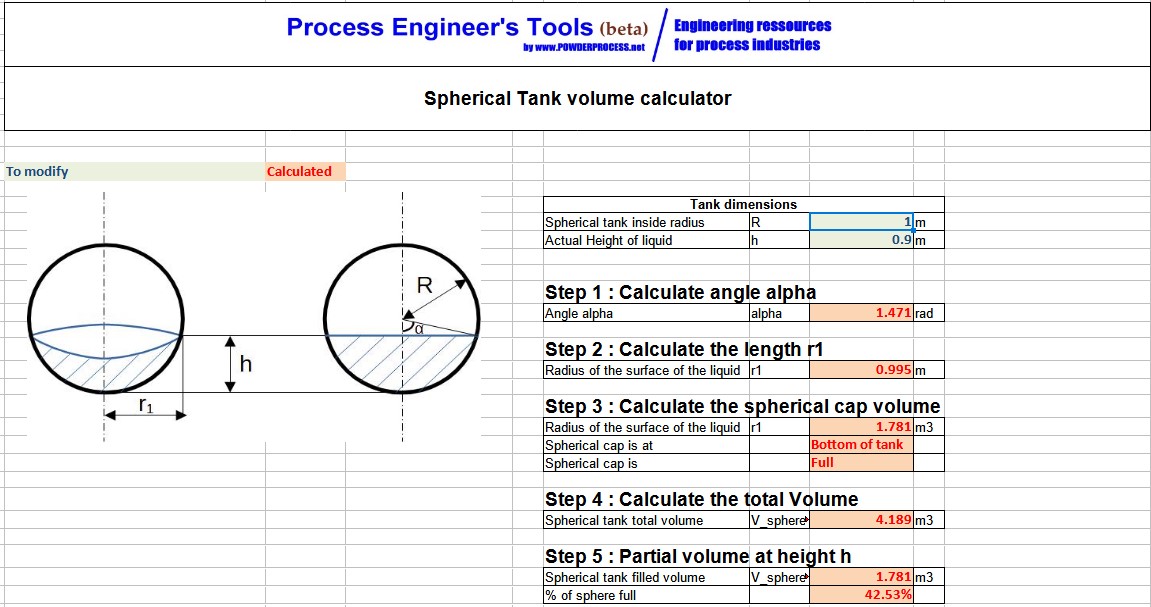
You can download a calculator to compute the volume of a partially filled spherical tank : Spherical tank volume calculator Excel.
Warning : this calculator is provided to illustrate the concepts mentioned in this webpage, it is not intended for detail design. It is not a commercial product, no guarantee is given on the results. Please consult a reputable designer for all detail design you may need.