
Liquid Water properties : correlations as a function of temperature
Formula for calculating Density, viscosity, thermal conductivity of water
Follow us on Twitter

Question, remark ? Contact us at contact@myengineeringtools.com
Quick Navigation:
Water critical parameters : [Dincer]
- \(T_c = 373.984\ ^\circ\text{C}\) (647.134 K)
- \(P_c = 220.64\ \text{bar}\) (22.064 MPa)
- \(v_c = 3.106\ \text{dm}^3/\text{kg}\)
Water triple point parameters : [Dincer]
- \(T_t = 0.01\ ^\circ\text{C}\) (273.16 K)
- \(P_t = 611.732\ \text{Pa}\) (0.006117 bar)
1. Liquid Water density correlation : \(\rho=f(T)\)
How does the density of liquid water vary with temperature ? What is the equation to calculate the density of water ?

With:
- \(\rho\) = density (\(\text{kg/m}^3\))
- \(T\) = temperature (\(^\circ\text{C}\))
- \(a = -2.8054253 \times 10^{-10}\)
- \(b = 1.0556302 \times 10^{-7}\)
- \(c = -4.6170461 \times 10^{-5}\)
- \(d = -0.0079870401\)
- \(e = 16.945176\)
- \(f = 999.83952\)
- \(g = 0.01687985\)
- Range of validity : \([-30 ; 150]\ ^\circ\text{C}\)
Note that an equivalent alternative expanded polynomial form is frequently found in literature:
2. Liquid water viscosity correlation : \(\mu=f(T)\)
How does the viscosity of liquid water vary with temperature ? What is the equation to calculate the viscosity of water ?
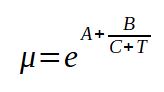
With:
- \(\mu\) = dynamic viscosity (\(\text{mPa}\cdot\text{s}\) or \(\text{cP}\))
- \(T\) = temperature (\(\text{K}\))
- \(A = -3.7188\)
- \(B = 578.919\)
- \(C = -137.546\)
- Range of validity : \([273 ; 373]\ \text{K}\) (\(0\) to \(100\ ^\circ\text{C}\))
3. Liquid water thermal conductivity correlation : \(\lambda=f(T)\)
How does the thermal conductivity of liquid water vary with temperature ? What is the equation to calculate the thermal conductivity of water ?

With:
- \(\lambda' = \lambda(T) / \lambda(298.15)\)
- \(\lambda(298.15) = 0.6065\ \text{W}\cdot\text{m}^{-1}\cdot\text{K}^{-1}\)
- \(\lambda(T)\) = thermal conductivity of liquid water at temperature \(T\) (\(\text{W}\cdot\text{m}^{-1}\cdot\text{K}^{-1}\))
- \(T' = T / 298.15\)
- \(T\) = temperature of water (\(\text{K}\))
- Range of validity : \([274 ; 370]\ \text{K}\) (\(1\) to \(97\ ^\circ\text{C}\))
4. Water saturated vapor pressure : \(P_{\text{sat}}=f(T)\)
How does the vapor pressure of water vary with temperature ? What is the equation to calculate the vapor pressure of water ?
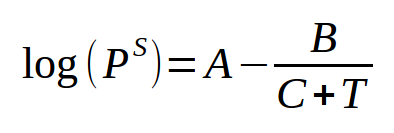
With:
- \(P^{\text{sat}}\) = Saturation vapor pressure (\(\text{mmHg}\)) — To convert to \(\text{Pa}\), multiply by \(133.322\ \text{Pa/mmHg}\)
- \(T\) = temperature (\(^\circ\text{C}\))
- \(A = 8.07131\)
- \(B = 1730.63\)
- \(C = 233.426\)
- Range of validity : \([1 ; 100]\ ^\circ\text{C}\)
💡 Plant Engineering Best Practices & Physical Limits
- Density Anomaly: Liquid water reaches its maximum density of \(\sim 999.97\ \text{kg/m}^3\) at \(3.98\ ^\circ\text{C}\). Below this temperature, water expands upon cooling until freezing.
- NPSH & Cavitation Risk: Always calculate Net Positive Suction Head Available (\(\text{NPSHa}\)) using the saturation vapor pressure (\(P_{\text{sat}}\)) at the maximum anticipated operating temperature. A sharp temperature rise drastically boosts \(P_{\text{sat}}\), triggering pump cavitation.
- Viscosity Impact on Pressure Drop: Liquid water viscosity drops by over 80% between \(0\ ^\circ\text{C}\) (\(1.79\ \text{cP}\)) and \(100\ ^\circ\text{C}\) (\(0.28\ \text{cP}\)). Pipeline friction factors and motor loads for cold water systems are significantly higher than hot boiler feed systems.
- Correlation Limits: Do not extrapolate these simplified industrial empirical equations above \(100\ ^\circ\text{C}\) (\(373\ \text{K}\)) for vapor pressure or thermal conductivity without checking High-Temperature IAPWS-95 formulation standards.
5. Water properties : Free Interactive Calculator & Excel Tool
Use our interactive online calculator below or download the standard Excel calculation tool to quickly execute water property calculations.
⚡ Liquid Water Properties Calculator
Excel Calculation Tool Screenshot:

References & Sources
[Dincer] Drying Phenomena: Theory and Applications, First Edition. İbrahim Dinçer and Calin Zamfirescu, John Wiley & Sons
[NIST] Standard reference data for the thermal conductivity of water, Ramires et al, American Institute of Physics and American Chemical Society, 1995
[DDB] Dortmund Data Bank (online)
[Kell] Kell, G. S. Density, Thermal Expansivity, and Compressibility of Liquid Water from 0° to 150°C: Correlations and Tables for Atmospheric Pressure and Saturation Reviewed and Expressed on 1968 Temperature Scale, J. Chem. Eng. Data, 1975, 20 (1), pp. 97-105