
A Comprehensive Guide to Check Valves in Piping Systems
Follow us on Twitter 
Question, remark ? Contact us at contact@myengineeringtools.com
1. Introduction
2. Design Considerations of Check Valves
1. Introduction
In the intricate world of piping systems, the role of check valves
is paramount. These unassuming devices serve as silent guardians,
preventing the backflow of fluids and ensuring the smooth operation
of numerous industrial processes. In this comprehensive guide, we'll
explore the different types of check valves, delve into critical
design considerations, and address common troubleshooting issues.
Let's unlock the potential of check valves in piping systems.
The different Types of Check Valves
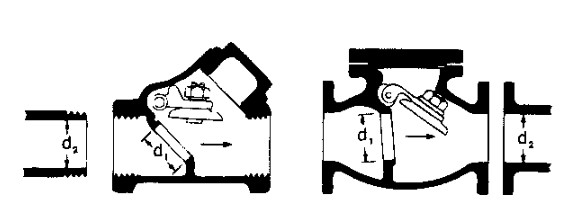
Swing Check Valves : Swing check valves are known for their simple yet effective design. The swinging disc allows fluid to flow in one direction while preventing backflow. Pros include low maintenance requirements, but they may be limited in high-flow applications and are susceptible to water hammer.
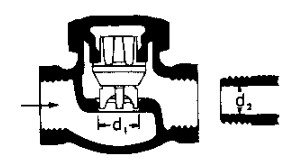
Lift Check Valves : Lift check valves, suitable for vertical pipelines, operate by lifting the disc against gravity during flow. They offer less pressure drop but can be prone to water hammer and might not be ideal for high-pressure systems.
Ball Check Valves : Quick to respond, ball check valves use a spherical disc to control flow. They are versatile for both horizontal and vertical installations but may be limited in high-pressure applications and susceptible to wear.

A ball check valve is a type of check valve where the closing
member, the movable part that blocks the flow, is a spherical ball.
The ball moves up and down inside the valve depending on the flow
and seals against the machined seat when no flow or reverse flow
occurs.
Here's how it works:
- When the pressure behind the seat exceeds that above the ball, liquid is allowed to flow through the valve.
- Once the pressure above the ball exceeds the pressure below the seat, the ball returns to rest in the seat, forming a seal that prevents backflow.
- The ball rotates during operation, which helps to keep the valve clean.
Ball check valves are commonly used in wastewater applications,
fire protection systems, irrigation systems, and on the outlet side
of pumps to protect the pump. They are often preferred for use in
pumping stations as they are self-cleaning and require minimal
maintenance. If a ball check valve makes noise, it is typically due
to insufficient pump capacity or water hammer issues. Different ball
weights can be used to prevent these issues².
Diaphragm Check Valves : Diaphragm check valves utilize a flexible diaphragm to control flow. Virtually free from water hammer, they are suitable for slurry applications but may have limitations in high-pressure and high-temperature environments.
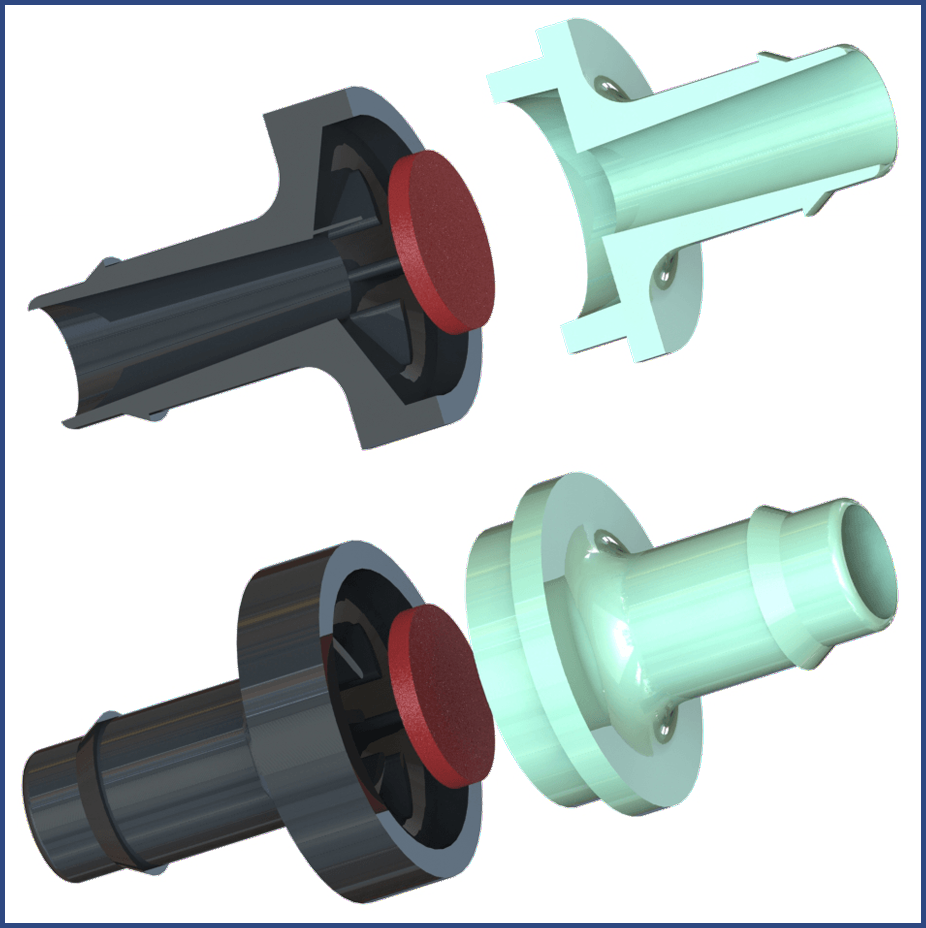
A diaphragm check valve is a type of non-return valve that is
commonly used in fluid handling systems to prevent backflow. It is
designed with a flexible diaphragm that seals against the valve body
to provide a tight shutoff and prevent fluid leakage.
Here's how it works:
- A self-centering flexible elastomer disc is the working part of this type of diaphragm check valve.
- The valve body keeps the disc centered over the seating area or sealing surface of the valve.
- The sealing surface is on the inlet side of the check valve body.
- Backflow causes the flexible rubber disc to lie down across the curved sealing surface.
- This closes the opening to the inlet port.
- The closed check valve prevents upstream flow back through the inlet port.
- Positive flow towards the outlet or exit port causes the disc to lie against this seat.
- The media then flows around the disc, through the channels and
out through the exit port of the check valve.
2. Design Considerations of Check Valves
2.1 Installation Orientation
Consider the orientation of check valves, whether vertical, horizontal, or angled. The choice depends on the specific requirements of the system.
2.2 Material Selection
Choose materials compatible with the fluid to avoid corrosion and ensure a long service life. Consider factors such as chemical resistance and durability.
2.3 Sizing and Flow Characteristics
Properly size check valves to match the pipe diameter, avoiding flow restrictions. Understand the flow characteristics to optimize performance.
2.4 Cracking Pressure
Set the cracking pressure, the pressure at which the valve starts to open, to prevent backflow and maintain system integrity.
2.5 Maintenance and Accessibility
Top
5 Most Popular
1. Pressure drop
2. Reynolds Number
3.
Pressure drop K coefficients
4. Churchill equation
5. Moody diagram
Prioritize valves with easy maintenance procedures and accessible
components. This ensures swift and efficient repairs when needed.
3. Troubleshooting of Check Valves
Check valves, while essential components in piping systems, can experience several common issues. Understanding these issues is crucial for efficient troubleshooting and maintenance. Here are some common problems associated specifically with check valves :
3.1 Reverse Flow or Backflow
Issue : One of the primary purposes of a check valve is to prevent
reverse flow, but if the valve fails to close properly, backflow can
occur.
Causes : Damaged or worn-out sealing surfaces, foreign objects
preventing proper closure, or incorrect installation.
3.2 Water Hammer
Issue : Rapidly closing check valves can generate a pressure wave
known as water hammer, causing stress on the valve and the piping
system.
Causes : Sudden valve closure due to high flow rates, incorrect
sizing of the valve, or lack of water hammer prevention devices.
3.3 Noise and Vibrations
Issue : Check valves, especially swing and lift types, can produce
noise and vibrations during operation.
Causes : Rapid closure, water hammer, or inadequate support for the
valve leading to vibrations.
3.4 Leakage
Issue : Check valves may experience leakage, allowing fluid to
pass through even when the valve is supposed to be closed.
Causes : Damaged seals, worn-out components, foreign material
preventing proper sealing, or incorrect installation.
3.5 Chattering
Issue : Chattering refers to the rapid opening and closing of the
check valve, causing wear and reducing its operational life.
Causes : water hammer, or inadequate sizing of the valve for the
specific application.
3.6 Cavitation
Issue : Cavitation occurs when vapor bubbles form and collapse
within the valve, leading to erosion and damage.
Causes : High-velocity flows, abrupt changes in pressure, or
improper valve sizing.
3.7 Failure to Open
Issue : In some cases, check valves may fail to open, hindering
the normal flow of fluid.
Causes : Sticking of the valve due to debris, inadequate spring
tension (in spring-loaded check valves), or issues with the hinge
mechanism.
3.8 Excessive Wear
Issue : Wear and tear on the moving parts of the check valve can
lead to reduced efficiency and eventual failure.
Causes : Continuous operation in abrasive conditions, lack of proper
lubrication, or using the valve beyond its specified service life.
3.9 Improper Installation
Issue : Incorrect installation can lead to various problems,
including inadequate sealing, increased wear, and reduced
performance.
Causes : Incorrect orientation, improper alignment, or not following
the manufacturer's installation guidelines.
3.10 Corrosion
Issue : Corrosion can deteriorate the material of the check valve,
affecting its structural integrity and performance.
Causes : Exposure to corrosive fluids, inadequate material
selection, or lack of protective coatings.
💡 Industrial Piping Best Practices & Rules of Thumb
- Standard Liquid Velocities: For sizing liquid pipelines, design for a normal velocity range of 1.5 to 2.5 m/s (5 to 8 ft/s). Avoid exceeding 4.5 m/s (15 ft/s) to prevent erosion, cavitation, and devastating water hammer forces.
- Anti-Chatter Rule: To protect check valves from chattering, the operating velocity should ideally be at least 20% to 30% higher than the minimum calculated opening velocity (\(v_{actual} \ge 1.3 \times v_{min}\)).
- Installation Orientation: Swing and ball check valves are ideal for horizontal runs. For vertical upward flows, spring-assisted lift or ball check valves should be specified. Never install a standard swing check in a vertical downward line as gravity prevents it from closing properly.
- Preventing Water Hammer: In high-head pumping systems, standard swing check valves slam shut under backflow, producing dangerous pressure transients. Specify non-slam nozzle check valves or fast-closing spring-loaded dual plate check valves to mitigate water hammer.
4. Minimum velocity for opening check valve : Calculation
To prevent "chattering" (the rapid opening and closing of the valve disc), check valves must be sized such that the fluid velocity is sufficient to keep the disc in its fully open position against the force of gravity or springs.
The minimum fluid velocity required to hold a check valve fully open is calculated using the empirical correlation from the Crane Technical Paper No. 410:
Where:
- \( v_{min} \) = Minimum velocity of fluid required to fully open the valve, in \( \text{ft/s} \) (or converted to \( \text{m/s} \)).
- \( C \) = Valve coefficient (empirical, dimensionless), depending on valve type and geometry.
- \( V_s \) = Specific volume of the fluid, in \( \text{ft}^3/\text{lb} \) (which is the reciprocal of fluid density, \( V_s = 1/\rho \)).
If the actual pipeline velocity \( v_{actual} \) is less than \( v_{min} \), the disk will not remain fully open and will oscillate (chatter), leading to rapid mechanical wear, hinge pin fatigue, and eventually premature valve failure or loud vibrations.
📊 Check Valve Minimum Velocity Calculator
Design Inputs
Calculation Results
Sources :
- Crane Co. Technical Paper No. 410 (Flow of Fluids Through Valves, Fittings, and Pipe)
- Valve Manufacturers Association of America (VMA) - Valve Basics
- Smith, L. (2018). "Fluid Mechanics of Valve Selection for Piping Systems." Journal of Fluid Dynamics in Piping Systems, 42(3), 215-230.