
Thermodynamics : free online Process Engineering Handbook
Follow us on Twitter

Question, remark ? Contact us at contact@myengineeringtools.com
Subsite content for Thermodynamics
Thermodynamics – Liquid Vapor Equilibrium : Ideal Mixture
Explore the world of liquid-vapor equilibrium, a crucial concept in processes like distillation. This page unveils the essence of equilibrium, where liquid and vapor phases coexist harmoniously. Delve into flash operations, essential in refineries and petrochemical processes, unveiling equilibrium in a flash drum. Witness the intricacies of equilibrium calculations, with a focus on ideal mixtures governed by Raoult's Law. Unravel the equilibrium coefficient's significance, deciphering a component's volatility and its role in distillation. Learn about relative volatility, a key player in distillation efficiency, and understand how pressure influences this dynamic equilibrium.
Thermodynamics – Liquid Vapor Equilibrium : Non Ideal Mixture
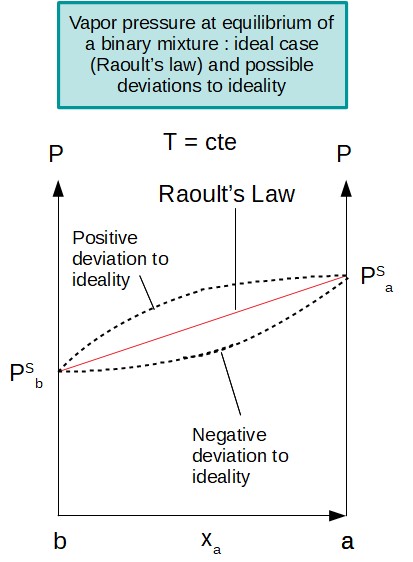
Explore the intricacies of non-ideal mixtures in liquid-vapor equilibrium. Unlike ideal scenarios, these mixtures deviate from Raoult's Law, introducing complexities in understanding vapor pressure. Uncover the role of activity coefficients, correcting vapor pressure predictions based on deviation. Delve into fugacity, an effective pressure governing equilibrium in non-ideal mixtures. Discover how fugacity coefficients, determined by equations of state like Soave-Redlich-Kwong, contribute to equilibrium calculations, shedding light on this vital aspect of chemical processes.
Thermodynamics
– Perfect Gas Law
Unlock the fundamentals of the ideal gas law—your key to understanding gas behavior. Ideal for low-pressure scenarios, it simplifies with assumptions of non-interacting molecules. Delve into molar volume calculations, conversion between mass and volume flow rates, and corrections for changing conditions. Uncover the specific heat nuances of ideal gases and access a handy Ideal Gas Law Excel Calculator. Master the essentials effortlessly.
Thermodynamics – Models for Real Gases
Delve into the intricacies of gas
behavior on this page. Starting with the ideal gas law and its
assumptions, explore the need for correction with the
compressibility factor. Understand the real gas law, adapting
molar volume, density, and flow rates. Discover the utility of
corresponding states, a tool for modeling both pure substances and
mixtures. Witness its application in two and three parameters,
including the influential acentric factor. The page serves as a
comprehensive guide to understanding the complexities of gas laws
and their practical applications.
Thermodynamics
– Equation of state
Unlock the essence of equations of
state, pivotal in understanding real fluid behavior. Delve into
their definition, linking pressure, volume, temperature, and
quantity. Explore fundamental equations like Van der Waals,
revealing insights into real gas intricacies. Encounter versatile
equations—Redlich-Kwong, Soave-Redlich-Kong, and
Peng-Robinson—capturing diverse scenarios. Learn the practical
applications, from calculating fluid properties to understanding
liquid-vapor equilibrium. This page offers a concise journey into
the realm of equations of state, empowering you to navigate and
apply them effectively.
Thermodynamics – Saturation pressure, Antoine law
Explore the essence of vapor pressure—a
crucial aspect in chemical and process engineering. Discover how
liquids inherently produce vapor, leading to a dynamic equilibrium
influenced by temperature. Uncover the fundamental Antoine law, a
widely-utilized approach to model saturation pressure. Delve into
the intricacies of Harlacher equation, offering an alternative at
higher pressures. This page provides valuable insights into vapor
pressure calculation methods, emphasizing their pivotal role in
applications such as liquid-vapor equilibrium and flash
calculations.
Thermodynamics – Dalton law
Understand the dynamics of ideal gas
mixtures effortlessly. As a blend of ideal gases mimics the
behavior of a pure ideal gas, the universal equation PV = nRT
holds true. Explore the concept of partial pressures, where each
gas in the mix contributes proportionally to the overall pressure.
Learn the calculation of partial pressures and grasp Dalton's law,
expressing the partial pressure as a product of total pressure and
molar fraction. Simplify conversions between molar and mass ratios
for comprehensive comprehension. Step into the realm of ideal gas
mixtures with clarity.
Flash equilibrium calculation of a mixture
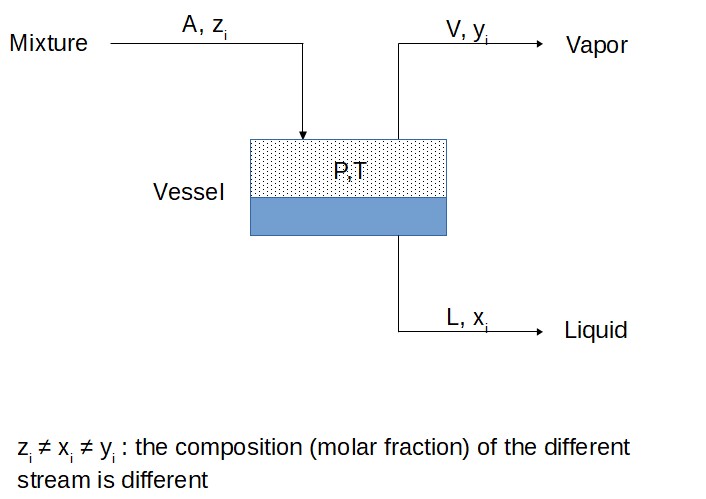
Unlock the secrets of liquid-vapor
equilibrium effortlessly. Whether dealing with a liquid at
saturation, vapor at saturation, or flash equilibrium, this
comprehensive guide navigates you through the intricate
calculations. Understand the material balance, component balance,
and equilibrium coefficients. With step-by-step procedures,
estimate temperatures, calculate equilibrium coefficients, and
ensure the system reaches equilibrium. Download the free Excel
calculator for a handy tool to simplify flash liquid-vapor
equilibrium calculations. Master the art of liquid-vapor
equilibrium with clarity and precision.
Steam turbines : steam mass flow requirement calculation step by step

Master the art of steam turbine calculations effortlessly. Whether you're delving into power plant operations or refining your understanding of these industrial workhorses, this page provides a practical guide. From defining steam conditions to calculating turbine efficiency, follow the step-by-step process. Understand the thermodynamic data, estimate efficiency, and determine steam mass flow requirements. With a helpful example and a downloadable Excel calculator, unravel the complexities of steam turbines with clarity and precision. Unlock the potential of steam for optimal energy generation.
Heat
pump sizing guide
This guide explains how to effectively size a heat pump for any building by following six key steps. The process includes calculating the heating load, selecting the appropriate power coefficient, considering the base outdoor temperature, adjusting for heat pump efficiency, and finalizing the proper model. It also compares heat pumps to gas-fired heaters in terms of operating costs, efficiency, and environmental impact, helping users make informed decisions for their heating needs.
Flash steam generation when reducing
condensate pressure
Insightful exploration of flash steam generation in steam engineering, detailing its occurrence when hot, pressurized condensate is released into a lower-pressure environment. It explains the thermodynamic principles behind this process, including the calculation of flash steam using enthalpy differences. The article highlights the significant volumetric expansion of flash steam, emphasizing its impact on system design and the potential for energy recovery in low-pressure heating applications. Practical considerations, economic benefits, and environmental advantages are discussed, alongside the use of data tables for quick reference in determining flash steam generation under various conditions.
Top 5 Most
Popular
1. Compressor
Power Calculation
2. Pump Power Calculation
3. Pipe Pressure
Drop Calculation
4. Fluid Velocity in pipes
5. Churchill Correlation (friction
factor)