BOD calculation step by step
Biochemical Oxygen Demand calculation
BOD calculation method, BOD calculation formula
Follow us on Twitter 
Question, remark ? Contact us at contact@myengineeringtools.com
1. STEP 1 : Gather data
2. STEP 2 : Calculate the BOD
3. Interactive BOD5 Calculator
4. Step by Step example : calculation of BOD5
5. BOD Calculator Excel
Environment protection is now a priority and water effluents from factories must be controlled to make sure they do not carry too much organic material. The BOD is one of the most common specifications to make sure the effluents will not harm rivers. This page explains how to calculate the BOD from laboratory data.
1. STEP 1 : Gather data
In order to calculate the BOD, the laboratory is sampling some waste water, then is diluting it in a BOD incubation bottle. The lab must measure the following data :
\(D_1\) = oxygen
diluted level in the diluted sample at t = 0 (mg/L)
\(D_2\) = oxygen diluted level in the diluted sample at t = 5 days (mg/L)
\(B_1\) = oxygen diluted level in the dilution water at t = 0 (mg/L)
\(B_2\) = oxygen diluted level in the dilution water at t = 5 days (mg/L)
\(V_1\) = volume of wastewater sampled for dilution (mL)
\(V_2\) = volume of diluted sample (mL)
BOD calculation can then be performed.
2. STEP 2 : Calculate the BOD
The BOD at 5 days can be calculated with the following BOD calculation formula:
With:
🧪 Interactive BOD₅ Sizing & Rating Tool
Diluted Sample (D)
Dilution Water Blank (B)
Wastewater Dilution Volumetric Data
📊 Calculation Results
💡 Industrial Wastewater Rules of Thumb & Safety Limits
Maximizing test accuracy and environmental compliance in wastewater systems requires standardizing limits and assessing biological health:
- Critical QA/QC Criteria (EPA Method 405.1):
- Minimum DO Depletion: The diluted sample must show a dissolved oxygen drop of at least 2.0 mg/L \((D_1 - D_2 \ge 2.0)\). Otherwise, the dilution is insufficient.
- Minimum Residual DO: The final residual DO (\(D_2\)) must be at least 1.0 mg/L to prevent complete anoxia, which limits microbial metabolic activity.
- Unseeded Blank Limit: Unseeded blank water depletion should not exceed 0.2 mg/L \((B_1 - B_2 \le 0.2)\). Higher blank depletion indicates water supply contamination.
- Typical BOD₅ / COD Ratios:
- For standard domestic untreated sewage, the ratio ranges between 0.4 to 0.8.
- A ratio < 0.3 indicates highly refractory/non-biodegradable organics or toxic compound presence, requiring seed adaptation or chemical pretreatment.
- Dilution Range Estimations: Untreated industrial wastewater usually requires significantly high dilution levels to stay within the dissolved oxygen measurement range of typical incubation bottles (typically 300 mL).
3. Step by Step example : calculation of BOD5
A factory has taken a sample of its effluents and sent it to the lab. The lab takes 10 mL of wastewater and dilutes it in a BOD incubation bottle of 250 mL. The lab measures the oxygen level in the diluted water and gets 10 mg/L at t=0 and 2 mg/L at t=5 days; it takes also the same measures on the dilution water and gets 9.5 mg/L at t=0 and 8 mg/L at t=5 days. The lab wishes to calculate the BOD₅ of the effluent.
Step 1 : collect the data
\(D_1\) = oxygen diluted level in the diluted sample at t=0 = 10 mg/L
\(D_2\) = oxygen diluted level in the diluted sample at t=5 days = 2 mg/L
\(B_1\) = oxygen diluted level in the dilution water at t=0 = 9.5 mg/L
\(B_2\) = oxygen diluted level in the dilution water at t=5 days = 8 mg/L
\(V_1\) = volume of wastewater sampled for dilution = 10 mL
\(V_2\) = volume of diluted sample = 250 mL
Step 2 : Calculate the BOD₅
\[f = \frac{V_2 - V_1}{V_2} = \frac{250 - 10}{250} = 0.96\]
\[P = \frac{V_1}{V_2} = \frac{10}{250} = 0.04\]
\[BOD_5 = \frac{(D_1 - D_2) - (B_1 - B_2) \cdot f}{P}\]
\[BOD_5 = \frac{(10 - 2) - (9.5 - 8) \cdot 0.96}{0.04} = \frac{8 - 1.5 \cdot 0.96}{0.04} = 164.0 \text{ mg/L}\]
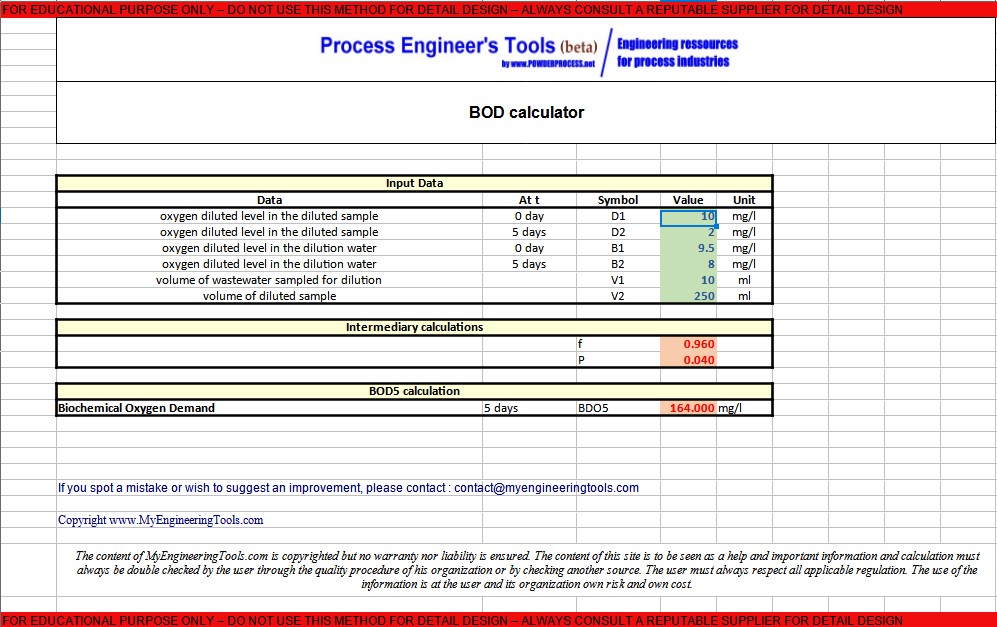
4. BOD calculator Excel
MyEngineeringTools.com has developed a free Excel calculator that allows you to calculate the BOD5 from the experimental data defined above : BOD calculator Excel
Warning : this calculator is provided to illustrate the concepts mentioned in this webpage, it is not intended for detail design. It is not a commercial product, no guarantee is given on the results. Please consult a reputable designer for all detail design you may need.