
Total Solids calculation step by step
Total solids, total volatile solids, total suspended solids, total dissolved solids
Follow us on Twitter

Question, remark ? Contact us at contact@myengineeringtools.com
The knowledge of the total solids amount in a water stream is basic data for all environmental engineering calculations such as the design of wastewater systems. This page explains how to calculate the total solids and total dissolved solids from water analysis data.
1. STEP 1 : Gather data
In order to calculate the total solids of a water stream, it is necessary to take a sample of the water and deliver it to a laboratory for gravimetric analysis. The engineer must gather the following data from the laboratory reports:
- \(V_{\text{sample}}\) = the sample size, in liters (L)
- \(m_{\text{dish}}\) = tare mass of evaporating dish (g)
- \(m_1\) = mass of evaporating dish + residue after evaporation and drying at 105°C (g)
- \(m_2\) = mass of evaporating dish + residue after ignition at 550°C (g)
- \(m_{\text{filter}}\) = tare mass of glass fiber filter (Whatman GF/C or equivalent) after drying at 105°C (g)
- \(m_3\) = mass of filter + residue after drying at 105°C (g)
- \(m_4\) = mass of filter + residue after ignition at 550°C (g)
2. STEP 2 : Calculate the total solid
The total solids (TS) in the water can be calculated with the following formula from the analysis results:
TS = (m1 - mdish) / Vsample
Where:
- \(TS\) = total solids (g/L)
- It is standard practice to express the total solids in mg/L by multiplying the result by \(1000\text{ mg/g}\).
3. STEP 3 : Calculate volatile and suspended solids concentrations
The analysis from the evaporating dish and the filter yields other critical indicators of wastewater quality.
Total Volatile Solids (TVS) calculation:
TVS = (m1 - m2) / Vsample
Where: \(TVS\) = total volatile solids (g/L) (representing volatile organic compounds burned off at 550°C).
Total Suspended Solids (TSS) calculation:
TSS = (m3 - mfilter) / Vsample
Where: \(TSS\) = total suspended solids (g/L) (retained by standard filtration).
Volatile Suspended Solids (VSS) calculation:
VSS = (m3 - m4) / Vsample
Where: \(VSS\) = volatile suspended solids (g/L).
Total Solids Analyzer (SI & Imperial)
| Parameter Name | Acronym | Value | Unit |
|---|---|---|---|
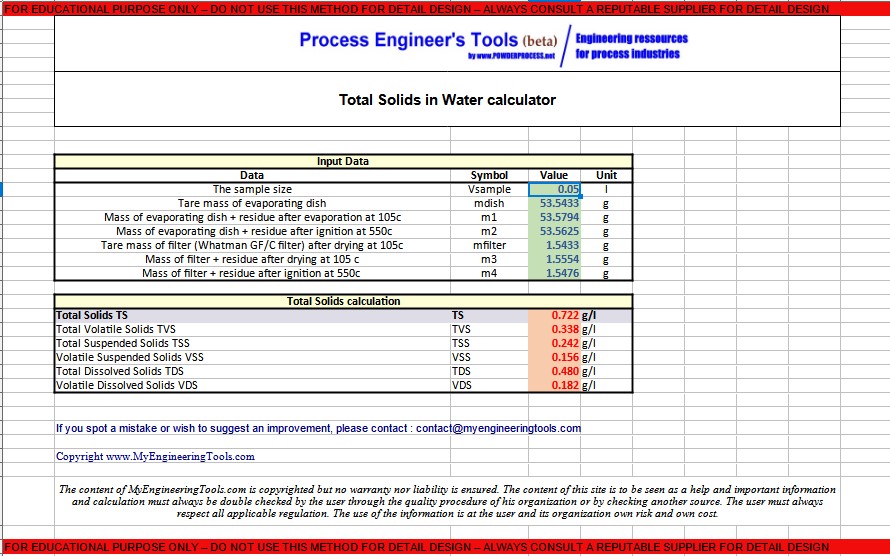
| Total Solids | TS | 0.722 | g/L |
| Total Volatile Solids | TVS | 0.338 | g/L |
| Total Suspended Solids | TSS | 0.242 | g/L |
| Volatile Suspended Solids | VSS | 0.156 | g/L |
| Total Dissolved Solids | TDS | 0.480 | g/L |
| Volatile Dissolved Solids | VDS | 0.182 | g/L |
💡 Plant Engineering Best Practices & Rules of Thumb
- Temperature Discipline: Ensure drying at exactly 103°C to 105°C. Excessive temperatures can volatilize ammonium bicarbonate and some organic fractions prematurely.
- Ignition Verification: Heavy chemical wastewater might require longer than 15-20 minutes in a 550°C muffle furnace to achieve complete carbon burn-off.
- Desiccator Storage: Always cool warm crucibles and filters inside a dry desiccator. Ambient humidity absorption can ruin accurate sub-milligram weighings.
- TDS Guidance: Generally, TDS levels below 500 mg/L are acceptable for municipal drinking systems. Levels above 1000 mg/L indicate high mineral content requiring treatment (RO/EDR).
4. STEP 4 : Total dissolved solids calculation
The concentrations calculated above allow process engineers to determine two other major indicators in wastewater treatment design: total dissolved solids (TDS) and volatile dissolved solids (VDS).
Total Dissolved Solids (TDS) calculation:
TDS = TS - TSS
Where:
- \(TDS\) = total dissolved solids (mg/L)
- \(TS\) = total solids (mg/L)
- \(TSS\) = total suspended solids (mg/L)
Volatile Dissolved Solids (VDS) calculation:
VDS = TVS - VSS
Where:
- \(VDS\) = volatile dissolved solids (mg/L)
- \(TVS\) = total volatile solids (mg/L)
- \(VSS\) = volatile suspended solids (mg/L)
5. Total Solids in Water calculator Excel
MyEngineeringTools.com has developed a free Excel workbook template that allows you to calculate the distinct total solids parameters defined above directly from analytical measurements: Total Solids in Water calculator Excel Download
Warning : this calculator is provided to illustrate the concepts mentioned in this webpage, it is not intended for detail design. It is not a commercial product, no guarantee is given on the results. Please consult a reputable designer for all detail design you may need.
Sources
[Chopey] Handbook of Chemical Engineering calculations, Chopey et al, McGraw Hill, 2004